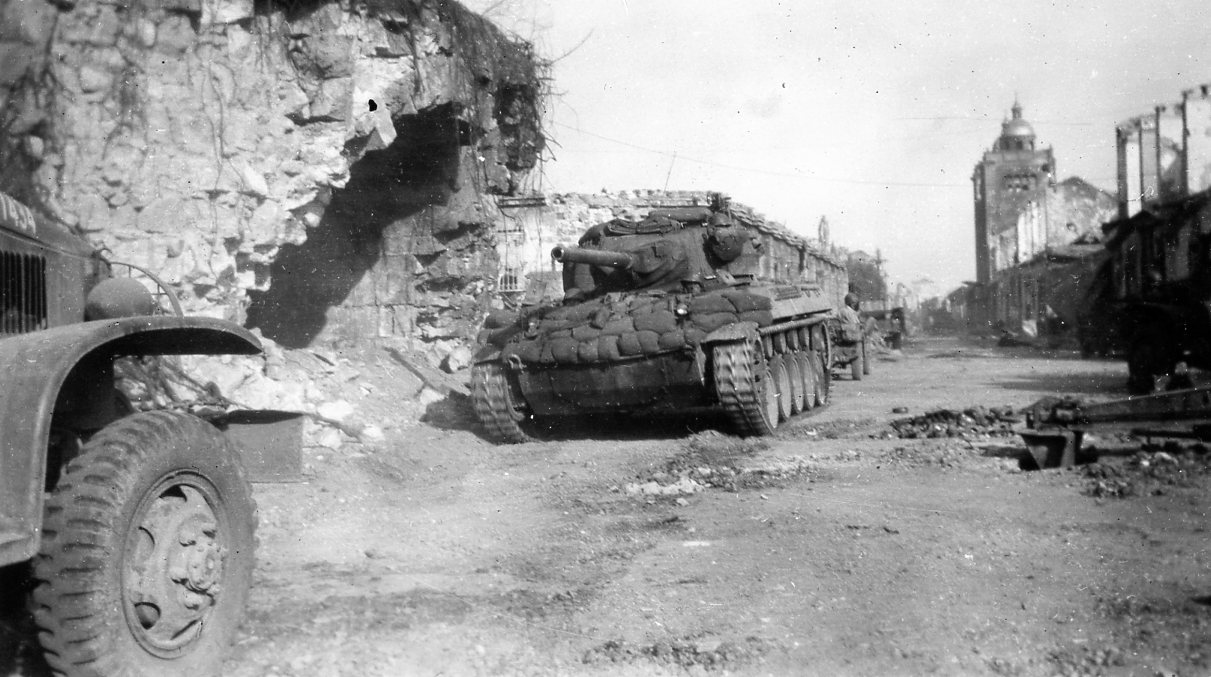
North of the Pasig River
On February 3rd, the 1st Cavalry dashed through the 37th lines, into Santo Thomas University and rescued American internees being held captive. On February 4th, the 37th advanced in two columns from the north. They encountered large areas of the city that the Japanese had set on fire. They also encountered fields with the bodies of Filipinos who had been hastily executed: they had been bound and bayonetted or had their throats cut. There were frequent but brief firefights, usually leaving 50-100 IJA dead and no prisoners. The 37th reached Old Bilibad Prison at 1900 where they rescued more than 1200 captives including more than 800 members of the US Armed forces. The 37th decided to keep these former captives at the prison because of increasing sniper fire in the streets. When a rescue convoy began moving the former captives, Japanese forces stationed in nearby buildings opened fire with machine guns. There were casualties among troops but not the among evacuees. That evening the Japanese aggressively began burning buildings near the Pasig River.
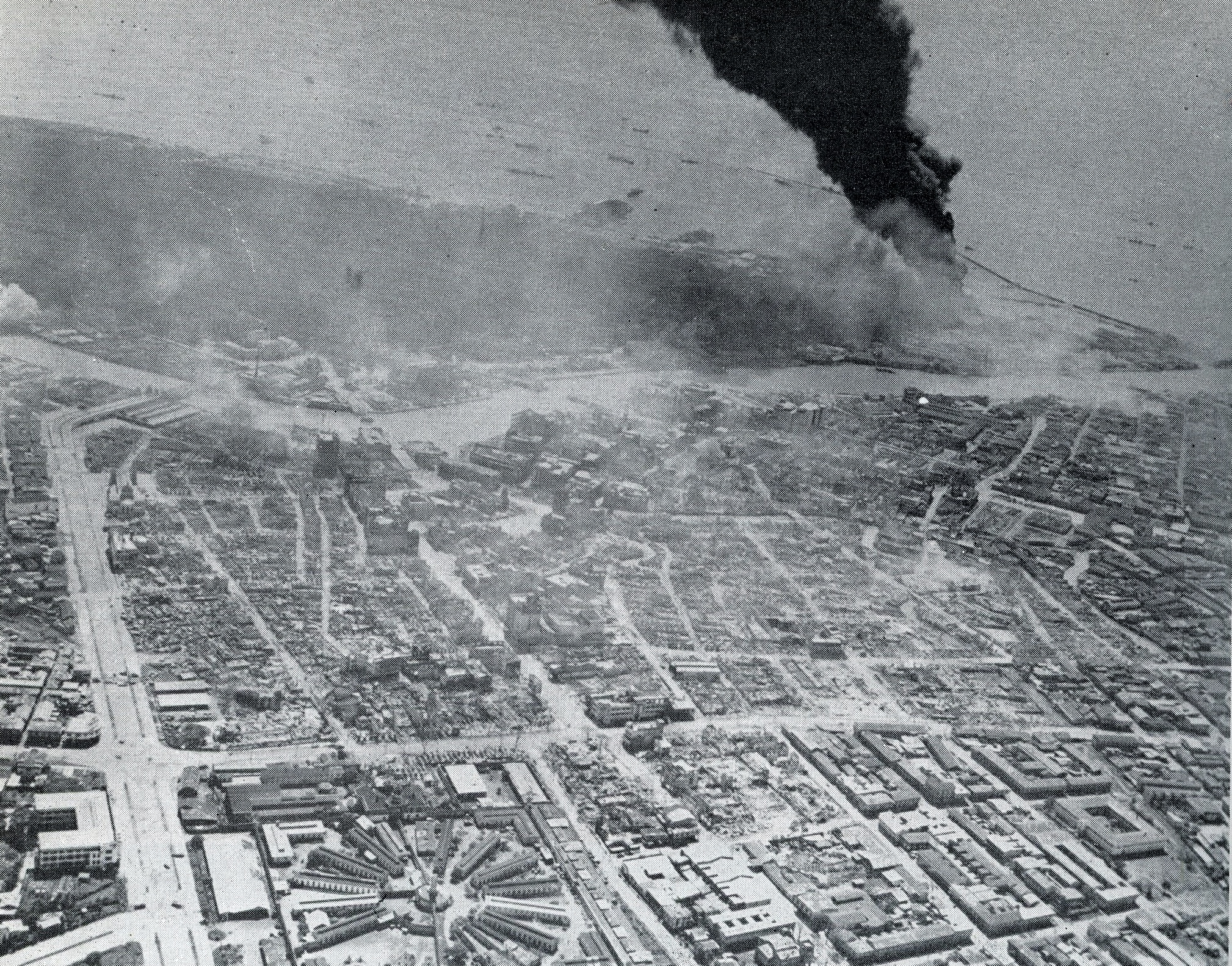
By daybreak on February 5th, the dust and smoke from the fires was so thick that US troops were unable to advance.
That night the fires within Manila raged on; the city glowed like a sunset.
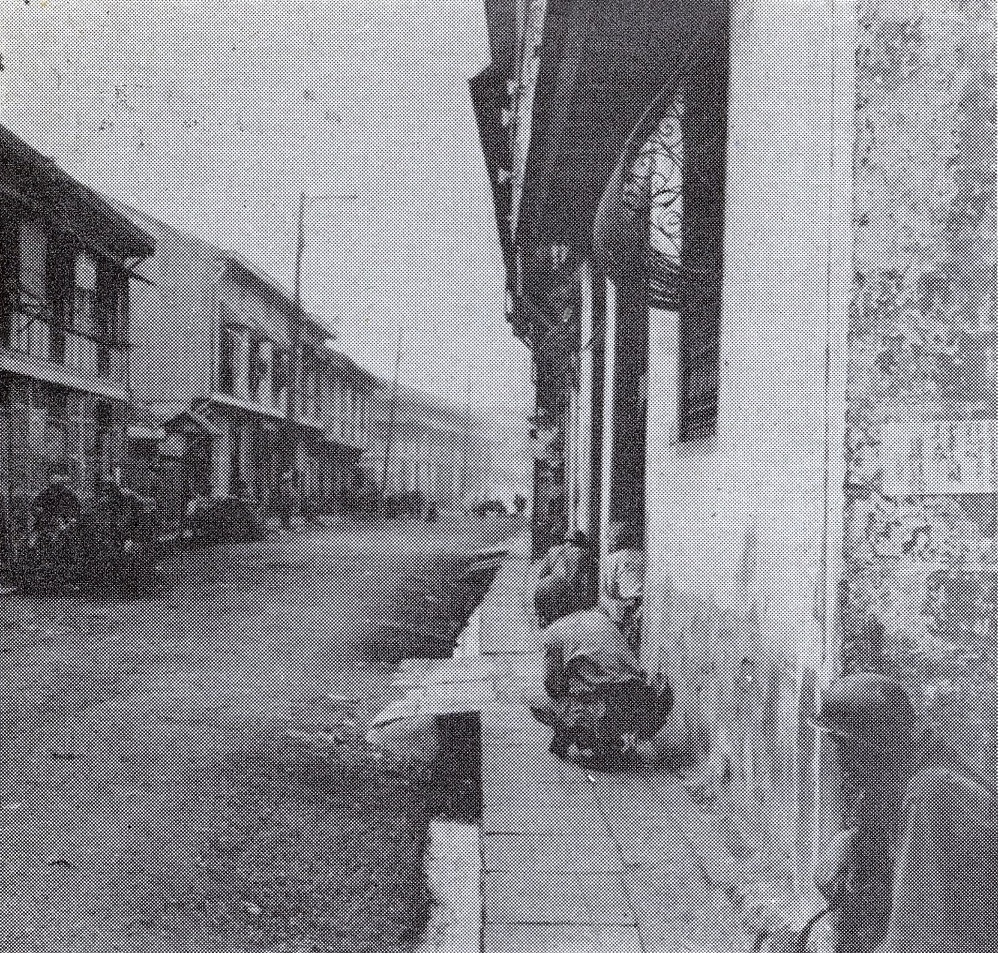
When the smoke cleared, the 37th crept forward. Each bridge they encountered was covered with anti-personnel mines. Always there
was the threat of enemy sniper and artillery fire.
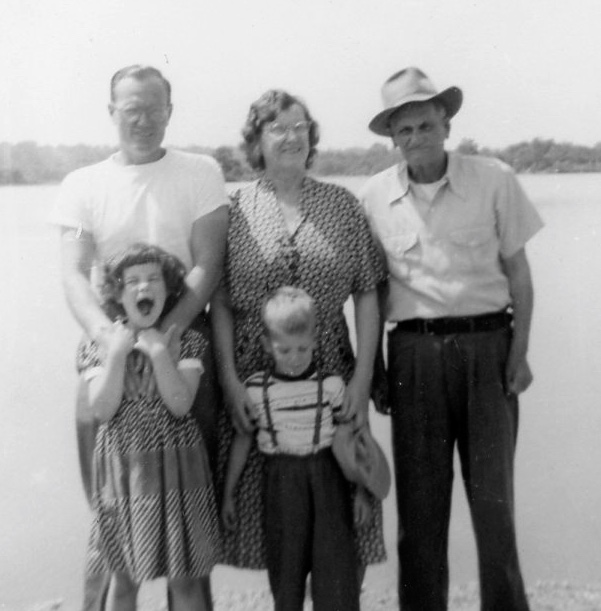
Dad adored his mother. I did also.
I spent many weekends with my Grandma Nance. She lived in Dayton, about a twenty-minute drive from our house. She lived in a small one bedroom apartment in a housing project. She had no yard, no car and no toys. And yet, I recall those weekends with great fondness. We spent hours together, playing cards, working jigsaw puzzles, talking and playing Chinese checkers.
She was one of those special people who found joy in almost everything. She had had a hard life, but her life stories were told not with bitterness but with humor and grace.
I expect she treated my dad the same way when he was a boy. It is easy for me to see why he loved her so.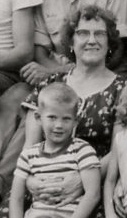
I recall a moment when I sat watching TV with Grandma in her small living room. She rose from the sofa, turned off the TV and retrieved a small shiny object from a nearby shelf. She sat in a rocking chair and began playing the harmonica, the chair rocking in rhythm with the tune. She was good. It hurts so much that I can’t recall those sounds.
Dad played the harmonica also. I can remember sitting and listening to him play. He was also good. My mom recalled that Dad carried his harmonica during the war. He told her that on quiet evenings on tropical islands he would play for his fellow GIs. He said that while they listened to the sad, plaintive melodies, they often looked east, sometimes with tears in their eyes.

It was February 6, and the battle for northern Manila was effectively over. The stage was set for crossing the Pasig River and the beginning of the battle for the heart of Manila.
The Central City
There were 13000 IJA troops defending the central part of the city.
The battle for central Manila began February 7, 1945, when the first amphibious assault forces crossed the Pasig River at 1400. They were supported by artillery which was limited to the firing of smoke shells for cover. General MacArthur ordered limited artillery shelling in an effort to save the city from destruction. The IJA used the upper stories of tall buildings in central Manila to shell GI troops as they crossed the Pasig River. The shelling included 200mm and 447mm rockets. These projectiles were so big they could be seen in flight. IJA rocket and artillery fire continued for five hours until Allied counter battery fire was ordered. Over the next few weeks the “front” consisted of locating and isolating the heavily outmanned and outgunned IJA positions within prominent and heavily fortified buildings where they were supported by machine gun fire, mine fields and mined structures. The earlier house to house battle north of the Pasig River now became a building to building battle.
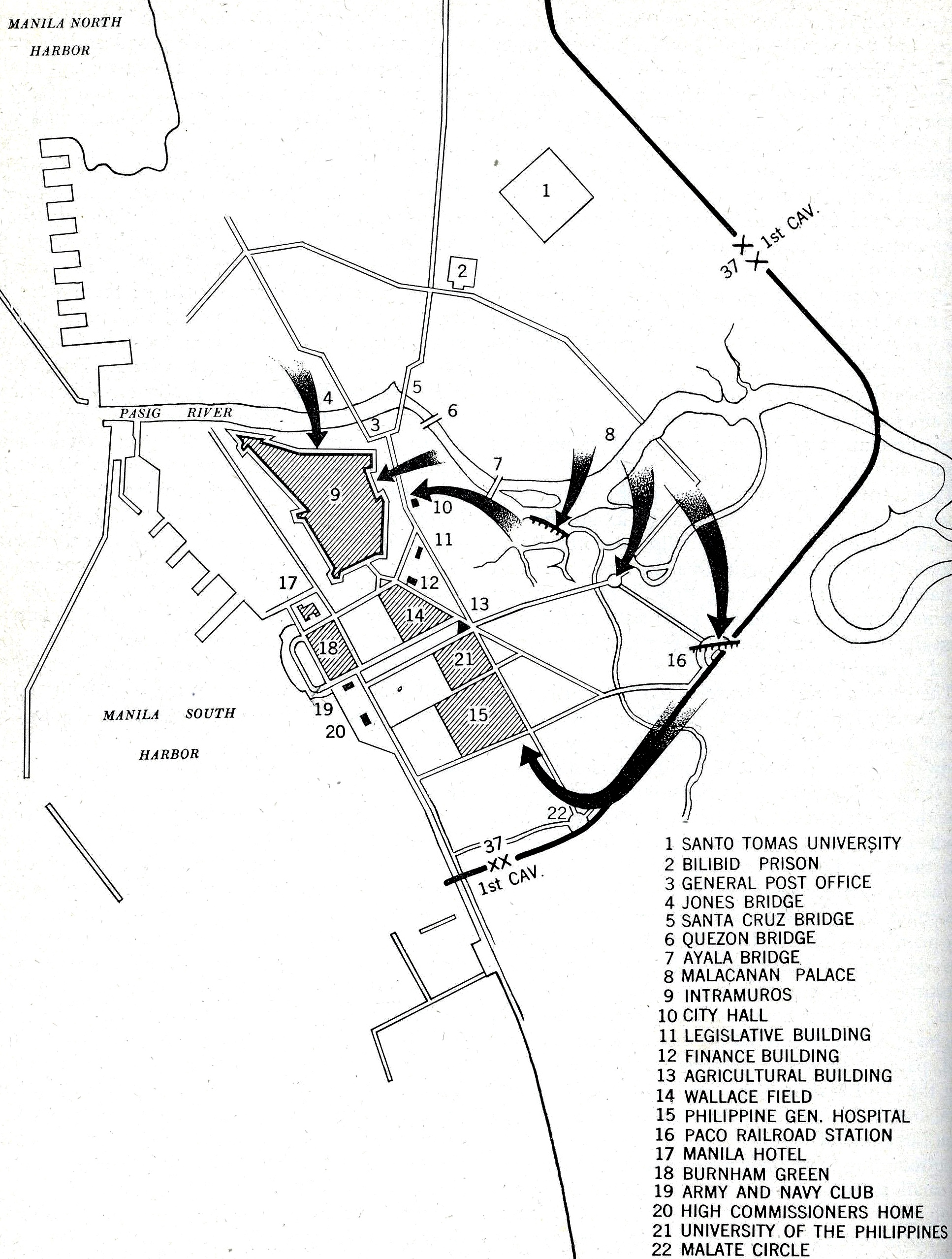
On February 8, forces from the 37th assaulted the Manila Municipal Power and Light building located on an island in the bay. The importance of the building was such that the Allies desired to seize it intact. This would require a frontal assault across water and subject the assaulting forces to constant and intense enemy fire. Early in the assault, an officer of the 37th with 16 men tried to cross in assault boats. Within minutes both boats were sunk and seven GIs were killed. The remaining nine swam to the island, but by the time they reached the shore, all were wounded. Enemy troops left the cover of the building and closed in on the band. One of the nine volunteered to swim for help and was killed in the crossing. The remaining eight held on, and 30 minutes later a second volunteer tried to return to the Allied lines and was killed. The supporting Allied troops onshore ignited barrels of oil and created a smoke screen enabling a third soldier to make it back across the river and to direct mortar fire to protect the six troops remaining on the island. On the mainland, Captain West of the 37th tied a rope to his waist and swam across to the island. He then used the rope to pull a boat over to the island and stayed while the wounded were pulled back. During the crossing the smoke screen cleared and three more were killed by Japanese machine gun fire. After all the wounded were recovered, West made it back to the mainland. He was awarded an Oak Leaf cluster to his Distinguished Service Cross for his actions. Allied forces took the power plant using M1s, BARs, light and heavy machine guns, motors, bazookas and white phosphorus and fragmentation grenades.

During the advance toward the railroad station, the troops of the 37th became pinned down under intense fire. PFCs Reese and Rodriguez – both using BARs – broke forward and alone toward the station where 300 IJA defenders were entrenched. They carried as much ammo as possible. Under constant fire and with limited cover, they crawled to within 50 yards of the station. For the next 2 ½ hours they fired nearly 1600 rounds into the station, killing at least 82 and wounding numerous others while taking out a 20-mm anti-aircraft gun and a heavy machine gun. Out of ammo, they withdrew. Reese was killed as they withdrew. Both men received the Medal of Honor.
The Allied commanders realized that the cost of taking every IJA-defended building without the use of artillery bombardment would result in significant GI casualties. MacArthur’s plan to spare the citizen and buildings of Manila was abandoned. Now every IJA-defended building was reduced to rubble by point blank artillery fire. In the cases of buildings with hardened concrete reinforcement, the 155mm canons were used.
When the Allies began using artillery at short range, the Japanese defenders changed tactics and began using locals as hostages or human shields. However, the Allied forces continued their use of short range artillery, including firing on the Philippines General Hospital and the University of Philippines where many civilian hostages were being held. It took two days to secure these buildings, freeing about 7000 captive civilians.
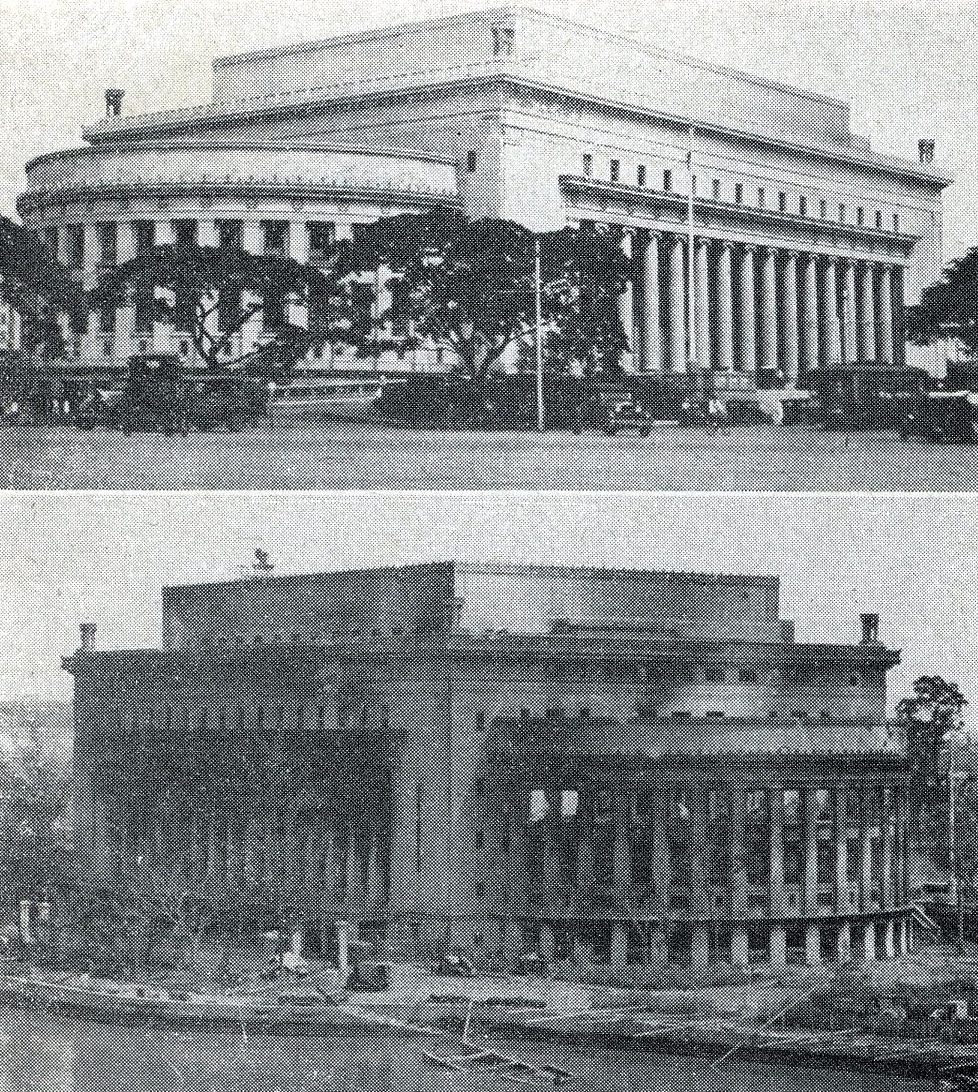
As artillery fire reduced buildings to rubble, many IJA troops withdrew into fortified basements and tunnels, requiring the infantry to fight room to room battles.
On February 21 and 22, the 136th artillery used 155MM canons to bombard the well-fortified City Hall, Water Works, Metro Theater and Post Office buildings.
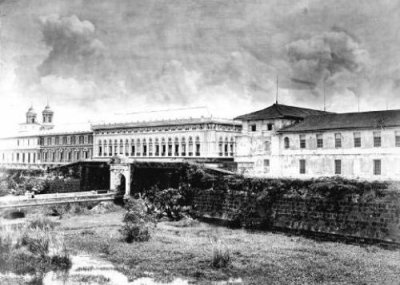
Later that evening the 136th artillery moved into position to begin shelling of Intramuros, the ancient inner-city walled fortress.
The next day, February 23, at 0730 the artillery opened fire on the northern entrance to Intramuros. The bombardment continued for one hour. The infantry advanced through the rubble and cleared buildings room by room. They encountered and freed hundreds of local civilians, all women and children, who were being held prisoner or used as human shields. The men prisoners had been moved to Fort Santiago where they were executed. Within two hours, 2000 civilians were evacuated. On February 23, Allied artillery batteries fired 7896 rounds.
The IJA held only a few buildings. They were among the finest and most beautiful buildings in Manila, including the Legislative, Finance and Agricultural Buildings. Their four-story facades faced open lawns and wide streets since they stood in the open within a detached city park.
They were modern earthquake proof buildings with heavily re-enforced concrete. Defended by 700 IJA, the buildings were also reinforced with sandbagged machine gun emplacements, and all window and doors were barricaded. Machine guns inside the building had been placed so that fire could be directed down hallways. On the morning of February 25, artillery, including Battery B of 136th, laid heavy fire on the Agricultural building. Over the next few days, the 5th cavalry rushed the building several times but each time was forced to withdraw due to heavy fire from the defenders. At 0800 on February 28, the 155MM canons returned and shelled the building for an hour. They repeated the shelling at 1000; Allied troops then charged the building at 1230 and secured it at 1425.

Early on the February 26th, 37th artillery began shelling the Finance and Legislative buildings.
Shortly after the shelling began, the Allied command received messages from the 1st Cavalry that they were coming under fire. It was discovered that 155MM shells were passing directly through the Legislative building and exploding near the 1st position. The problem was corrected and the shelling continued all day, slowly reducing the once grand buildings to rubble. Shelling stopped at 1700 and a surrender order was broadcast. By 1830 no response was received, so the shelling continued throughout the evening and into the night as the shells painted streaks of orange across the dark backdrop. At 0915 the next day, the infantry advanced into the building but met stiff resistance. They withdrew, and the artillery resumed the shelling. During the final infantry assault, PFC Cleto Rodriquez, who had won the MOH a few days earlier at the railroad station, charged into the building leading his platoon with his BAR. He knocked out a machine gun nest and charged down the hall and up the steps to the second floor killing six more IJA defenders. He was awarded the Silver Star. It took four days to secure the Legislative building.


The Finance building was next. The artillery shelling took place on March 1-2, with a break for a surrender broadcast. This time 22 IJA takers advanced under the protection of a white flag. Seeing their comrades, two more IJA surrendered. Before they could get to safety, one of the IJA soldiers was shot in the back. The initial attack on the Finance Building began March at 1120. A smoke screen was used so that the area surrounding the building could be cleared of mines. The initial attack was met with resistance, so the Allied troops withdrew. More shelling followed. This time phosphorus shells were used. The Finance Building was secured by 1800.
Dad’s heavy drinking episodes were often a source of family conflict, but, to be honest, when I recall some of those episodes, I find humor.
I attended college while living at home. One day when I was nearly 21 years old, Dad asked me to join him and go to a baseball game at Riverfront Stadium in Cincinnati to see the Reds. Some of his bar room buddies had chartered a bus. Dad was a Pittsburgh Pirates fan, but this trip combined baseball and beer, so to him it was a win-win situation. Early one summer morning, we drove to the Airway Inn in Fairborn, Ohio, and boarded a single level tour bus. Many people carried coolers filled with beer aboard. We made the trip to Riverfront in about an hour. Exiting the bus, we made our way into the stadium. I sat with Dad. As we took in the game, I had a beer and Dad drank several.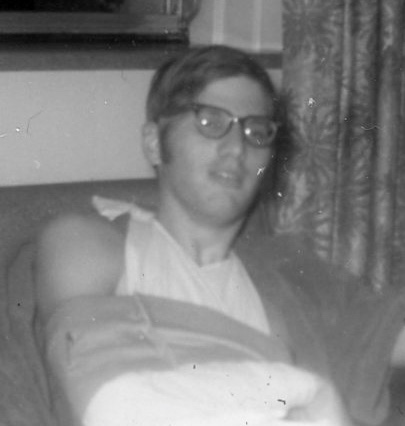
After the game, our group gathered and boarded the bus. Most of us were in good shape but there were a few suffering from an excess of beer who needed a bit of assistance. I particularly recall one young man who was wearing a bright red souvenir plastic batting helmet. The color of the helmet nearly matched the color of his eyes. As the bus pulled out of the stadium lot and made its way initially through bumper to bumper traffic, some of riders dipped into the coolers and continued to drink beer. The noise level reached that of a grade school bus dropping kids off on their last day of school. Dad and I didn’t sit together. He had found new friends and their cooler. I sat in a seat near the front of the bus and next to a slightly inebriated, but friendly oldster. We chatted as the bus continued north, picking up speed as the city traffic thinned.
We had driven about 30 minutes when a lively discussion occurred between the driver and some of his passengers. It seemed that some of the latter had a pressing need for a restroom and wanted the driver to exit the highway. At first the driver refused, but then the conversation grew louder. The patrons demanded then pleaded with the driver and forewarned of the potential disaster that might occur on the bus. The driver relented and we exited the Interstate highway, pulling our bus into a service station. The crisis passed, and we boarded the bus and headed towards the Airway Inn. The tension inside the bus was considerably less and there was now much laughter and loud talking and more beer drinking. Suddenly someone with a slight slur yelled, “Oh-oh! We’re missing some people.” Many on the bus glanced around trying to locate loved ones and friends. “Yep… we… are… missing… two… people.” The alcohol-numbed riders glanced around as if they might find the missing person perhaps hidden someplace nearby. I did not glance around. I knew. I turned to the red nosed man next to me and said, “I’ll bet you one of them is my dad!”
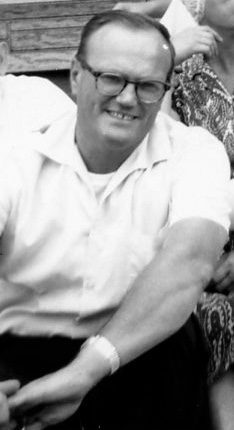 “Turn the bus around… We gotta go back,” someone yelled. I glanced at the driver and saw his shoulders slump. A few miles later, the bus exited the highway, crossed over, turned onto a ramp and we were heading south on I- 75. In a few minutes the bus exited again, passing near the service station we had recently visited. Many of the patrons were now standing, some swaying, as they stared out of the bus windows. There was an air of competitiveness, each hoping to be the first to spot the castaways. We had driven a few miles north on I-75, when one of the lookouts shouted, “I see ’em!” I abandoned my detached air, stood up and worked my way forward until I could see out of the front bus window. I saw two men on the shoulder of the highway. One was a young man wearing a bright red plastic batting helmet. He held out an arm as if reaching for the highway. His hand was clinched in a fist and his thumb was pointing up in the classic hitchhiker pose. But the effort seemed to have strained his sense of balance; his one leg was buckled, and he leaned heavily on the other man for support. On closer inspection, they both appeared to be leaning on each other. The other man was, of course, my dad. The bus pulled past the glassy-eyed and grinning men. For a moment they looked startled, thinking (a challenging exercise in their condition) that the bus driver was only going to slow down and pass them by. But, alas, the driver wasn’t a prankster. I expect he was trying very hard to end this trip and divorce himself from this group.
Dad and his red-capped friend boarded the bus to much laughter and a few good-natured jeers. Dad and his buddy staggered past me and found two empty seats. They sat for a moment, then got up and found a cooler filled with ice and each plucked out another beer.
The battle for Manila was over.
In the Battle of Manila, the IJA had suffered 16665 dead. The 37th, which was the main assault force, was credited with 13006 enemy killed. The 37th suffered 3732 casualties, including 461 dead.
 ww2letterproject
Great reading
LikeLike
I remember Marie as having a sweet lively personality. She could utter one liners that were of Gracie Burns type. Thank you for these postings & in particularly, to Steve for his personal stories. I loved your family & all the times we spent together. I regret not going to see your mom before she passed. Teresa & I would have been at the funeral, but unfortunately learned about it after the fact.
LikeLike
In Ken Burn’s documentary series “The War” is the story, told through the experiences of a young girl, of an American family that became prisoners early in 1942 and spent several years as POWs in Santo Thomas University in Manila before being liberated in February 1945 by Allied forces.
LikeLike