My wife and I stepped out of a cab at the North Vista Point of the Golden Gate Bridge. It was late morning, and the sun shone brightly in a blue sky filled with widely scattered clouds. We were robbed of the warmth of that sun when we were buffeted by a brisk wind. We made our way onto the sidewalk on the east side of the bridge and began the nearly two-mile walk across it enjoying spectacular views of the San Francisco skyline and Alcatraz Island. Near the mid-point of the crossing, I stopped and looked to my right across the deck of the bridge, staring out at the vast Pacific Ocean stretching to the horizon. Then I leaned over the rail to my left and looked down. More than 200 feet below, a large ship was passing…
It was noon on August 15, 2012.
–Steve Nance
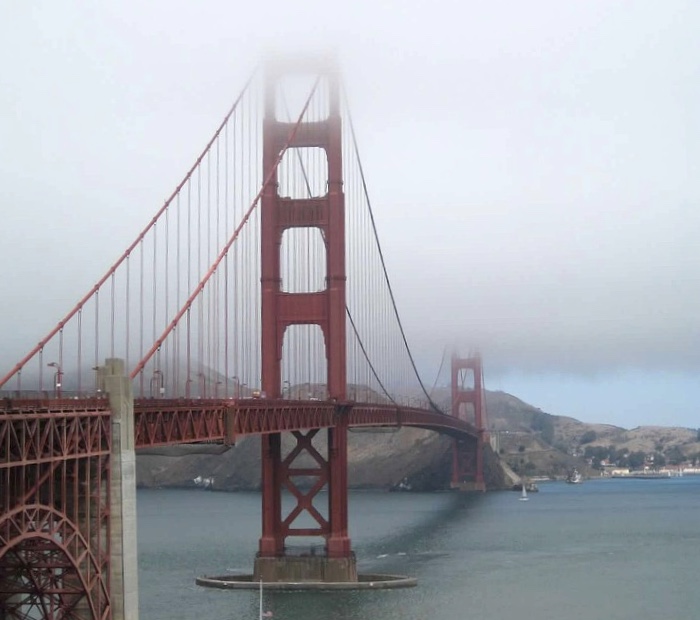
A convoy of ships begins to leave San Francisco Bay heading for open water. Behind them lie Alcatraz Island and the skyline of San Francisco; in front of them is the Pacific Ocean. A regimental band on one of the ships begins to play. The sounds of “A Dozen Roses” then “Don’t Sit Under the Apple Tree” fill the air. The decks of the ships are crowded with young, exited and anxious GIs. Among them is 21-year-old PFC Bill Nance. He glances out to sea and wonders about the dangers and adventures that lie beyond the western horizon. As the convoy passes under the Golden Gate Bridge, Bill glances up at the bridge deck several hundred feet overhead and strains to see the faces of the people crowded near the rail…
It is 2:00 PM on May 26, 1942.

Acknowledgement: Much of what is written here about the Ohio 37th Division was taken from The 37th Infantry Division in World War II by Stanley Frankel.


Bill Nance joined the Ohio National Guard in 1940 as war raged in Europe and Asia. Concerned about the threat posed by belligerents, the Ohio National Guard was activated as the 37th Infantry Division in September 1940. A 19-year-old Bill got his notice of induction and “enlisted” in the US Army in Dayton, Ohio, on October 15, 1940. He was assigned to Field Artillery. The enlistment period was for 52 weeks. Later that month, Bill and other members of the 37th made the 1000-mile trip to Fort Shelby, Mississippi and began basic training.

Upon their arrival groups of six men were assigned to a pyramid tent. Each tent contained a stove and a wood burning heater, a writing table and a radio.
Each man was assigned an overcoat, four uniforms (two cotton, two wool), several pairs of heavy socks, a steel cot with a mattress and two covers, three blankets, one pillow, two pillow cases, a new pair of field shoes, a raincoat, seven suits of underwear, a garrison cap for dress, a campaign cap for overseas and an eight-round, semiautomatic M1 rifle.
Pay was $21 per month. Basic training taught how to put up a tent and make a bed. There was rifle and small arms training as well as classes for first aid and fundamental military subjects.


Each weekday began at 0500 with calisthenics. Breakfast was at 0615. At 0650 there were field drills and at 1130, the noon meal. A second field drill began at 1250 with the recall from the field at 1630 for evening dinner. At 1800 it was back to barracks with bedtime at 2200.
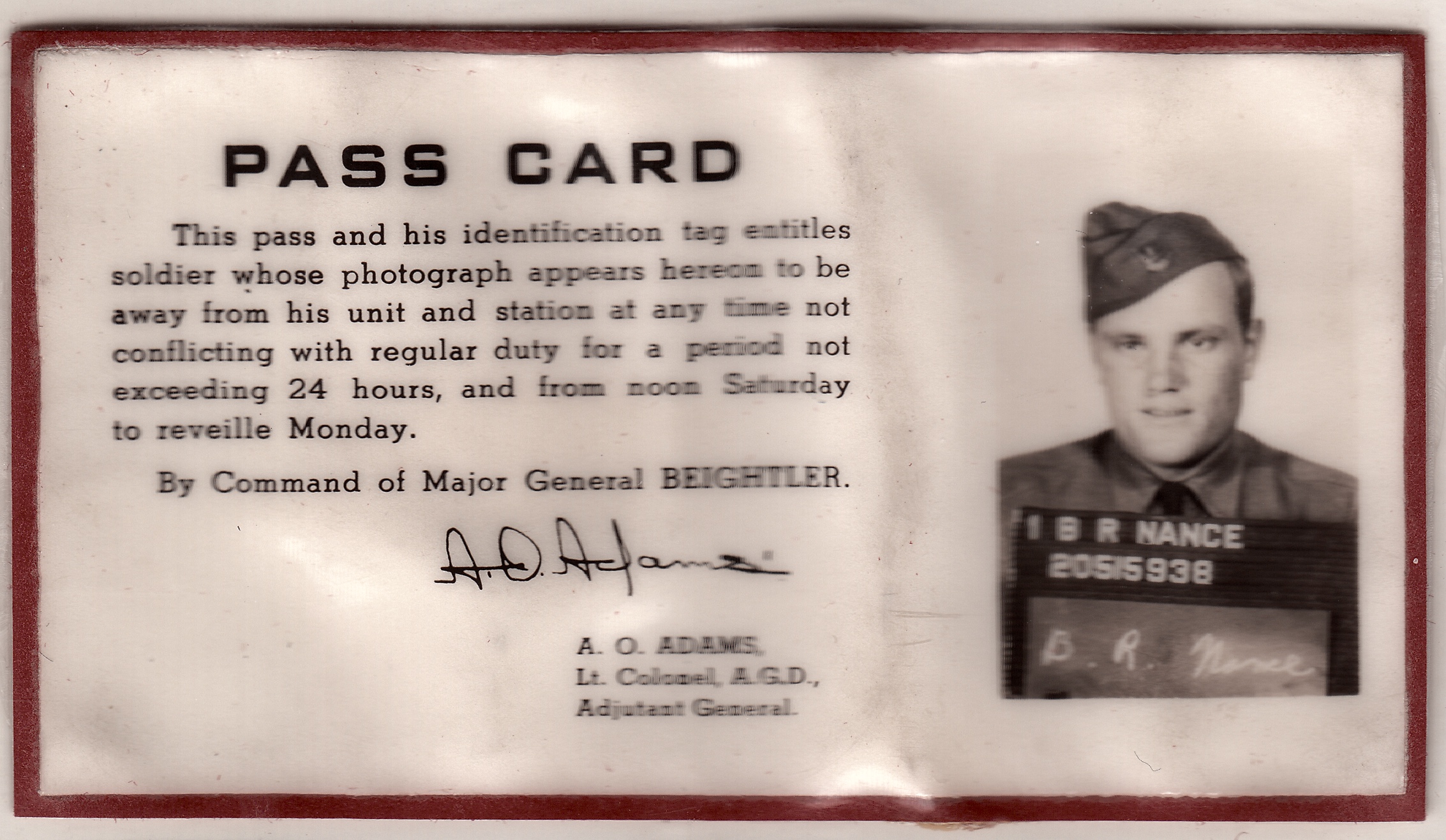 On the weekends men were off duty from Saturday afternoon to Monday morning.
Bill was assigned to the 136th Field Artillery Regiment. Field artillery training was done using 75 MM cannons.
During basic training the 136th made field trips to Biloxi, Mississippi and Mobile, Alabama.

The first holiday spent at camp was Thanksgiving. The menu was turkey with oyster dressing, chilled cider, cranberry sauce, salad, mince pie, cigars and cigarettes.
Basic training was completed and pay increased to $30 per month.


As Christmas of 1940 neared, there was a mass exodus toward Ohio; passes expired on January 2, 1941. Sixteen trains were commandeered to take the men home. The railroads charged a fare of one cent a mile making the fare from Camp Shelby, Mississippi to Dayton, Ohio about $10.
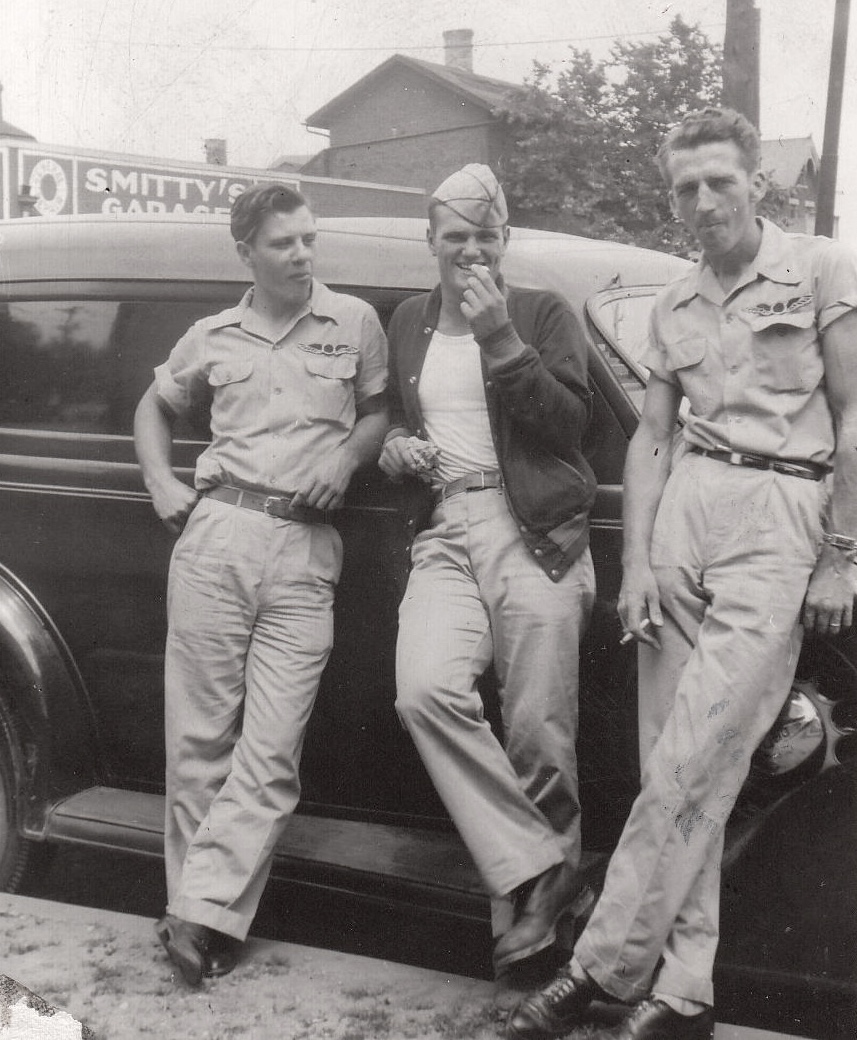
It is likely that Dad was home for the Christmas of 1940. I wonder what that Christmas was like. His family was poor and surely few, if any, gifts were exchanged.
My early childhood memories of Christmas are filled with images of a Christmas tree surrounded by many colorfully wrapped packages, a time of great bounty. We lived in a small, five room house, the Christmas tree was in the living room.
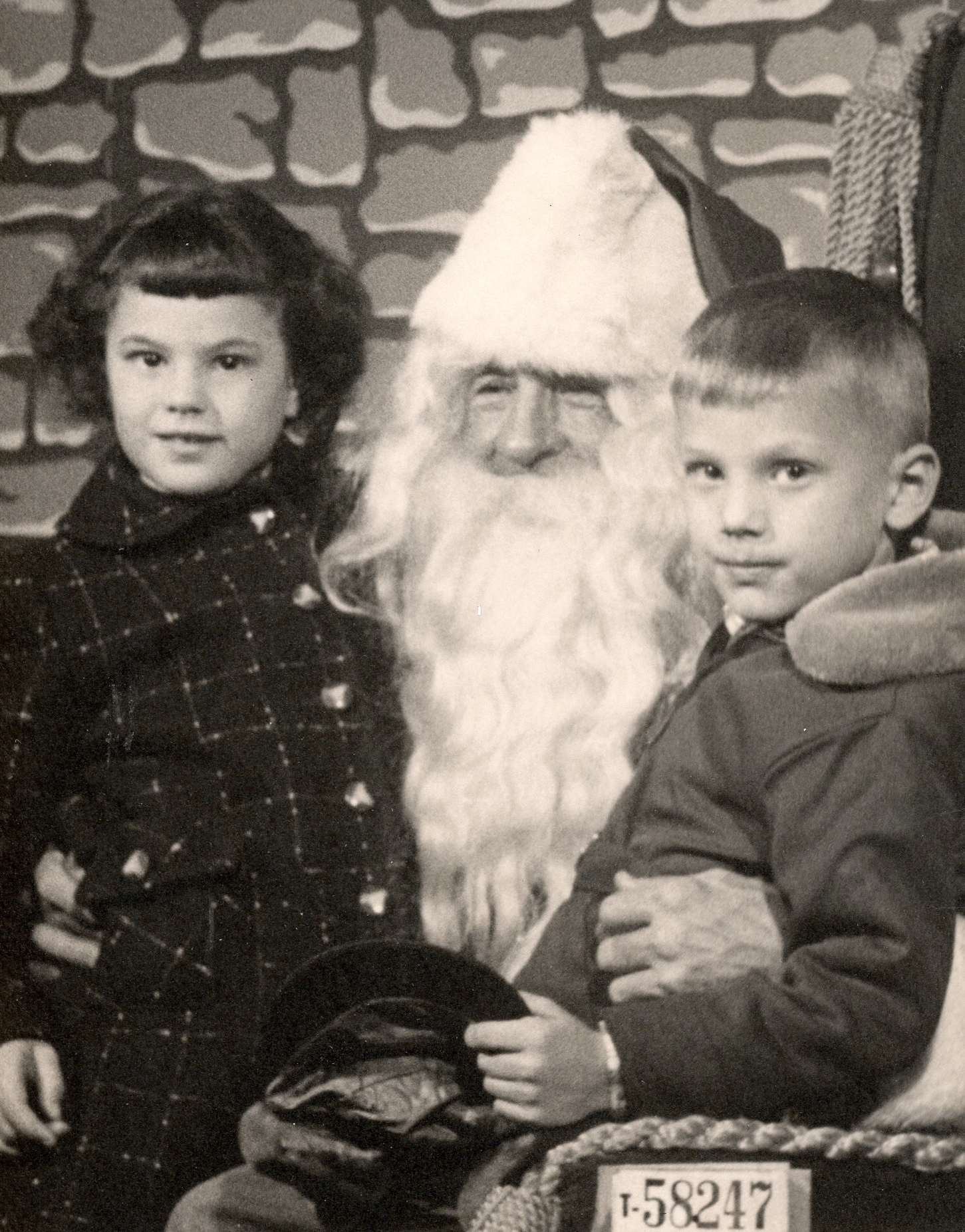
On Christmas Eve 1957, my sister Carol and I were in the small bedroom that we shared. It was dark outside. Hours earlier our parents had ordered us to “go to bed and go to sleep.” A sense of anticipation made it impossible to obey that command. My sister laid near the edge of her upper bunk bed, and I was in a similar position in the lower bunk. We talked in whispered tones. Earlier that month, Carol and I briefly had met with Santa Claus to confirm the priorities on our Christmas gift wish lists. We wondered if Santa would fulfill those wishes.
Suddenly our Christmas eve conversation was interrupted by a singular, faint but distinctive, “beep.” The noise had come from outside our bedroom wall that faced the back of the house. I wondered what kind of creature could make such a noise. Surely there weren’t roadrunners in Ohio? Carol quickly and quietly scampered down the wooden ladder hooked onto the edge of her bed. We crept towards the window, being careful to avoid those boards in the hardwood floor that were loose and uttered a loud “creak” when you stepped on them. We cautiously lifted a corner of the blind, tensing in case just on the other side we should discover someone or something staring back at us. We peered out the window and into the back yard and into the darkness. Glancing to the right we saw in the faint light from our neighbor’s windows, our driveway, our detached garage and Dad. Next to him was a beautiful blue and chrome bicycle. He opened the garage door and wheeled the beauty inside. It was identical to the bike my sister had picked out as her most-wanted Christmas present.
I was seven. Sure, I had my doubts about the realness of Santa but it had seemed safer to believe. As Dad exited the garage, he closed the door and also my belief in Santa. Although I was a bit wiser, it hurt to lose forever some of the wonder of Christmas.
We crawled back to bed and finally went to sleep. At the first light of dawn, we were awake. I whispered, “Do you think we can get them up?” My sister, older, wiser and more experienced in such matters replied, “Not yet.” I laid on my back staring upward at the mattress above supported by silver wire mesh. Finally, on her signal, we exited our beds and quietly opened our bedroom door. We crept along the short hall towards the closed door of our parents’ bedroom. We passed the archway on our left that lead to the dining room and the adjoining living room, and now just a few feet away, treasure. We gently tapped on our parents’ bedroom door. Someone groaned, “It’s too early.” “But he’s been here!” we pleaded. “Ok… ok… but wait right there.” We heeled and waited and waited and waited as the seconds passed.
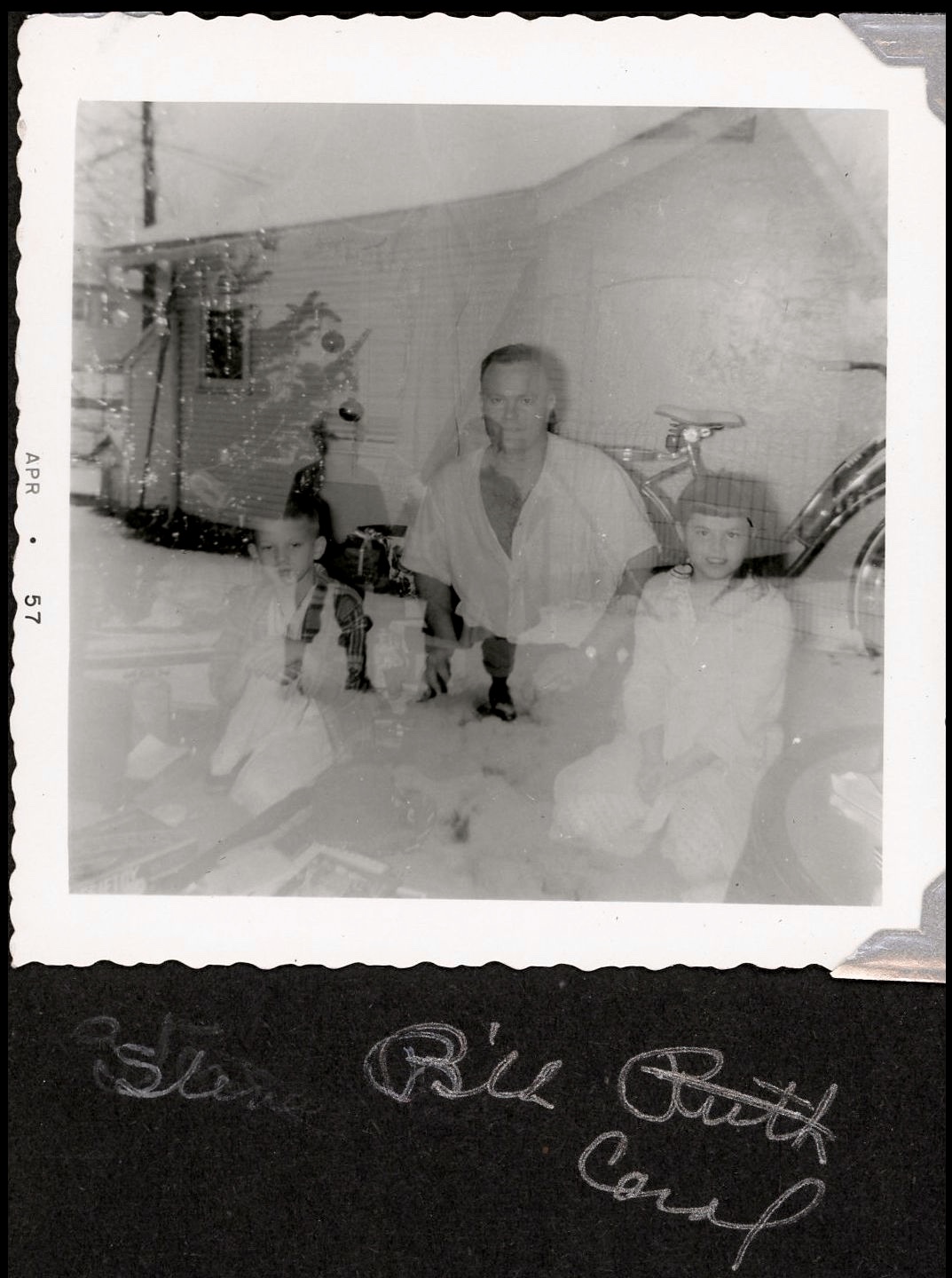
At last their bedroom door opened. Mom and Dad were dressed in robes. They looked so sleepy. Carol and I stared into the face of first one parent then the other waiting for the command. Mom said, “Ok….” and before she could add, “…Go,” we bolted towards the living room and the Christmas tree. Soon the room was filled with the sounds of tearing paper and squeals. Leaning against the wall was a blue and chrome Huffy bicycle with a push button horn.
Later that day, we told our parents about discovering Dad hiding the bike, noting that it was Dad’s testing of the horn that gave “Santa” away. I don’t recall, but I expect Mom looked at him sternly considering his behavior inappropriate. I also expect Dad smiled or laughed. Dad always had a sense of child about him. He loved to play.
The monotony of daily training continued. June 1, 1941, the 37th began maneuvers. The 136th traveled to Baton Rouge. Near the airport, they set up pup tents. It rained for 28 of the 30 days they were on maneuvers. Reveille was at 0300 and a hot supper at 2000. Near the end of the month maneuvers ended, and the men returned to Camp Shelby.
On August 21, 1941, by executive order of President Roosevelt, tours were extended an additional 18 months, a crushing blow to those nearing the end of their year of service.
During August and September, it was back on the road for maneuvers in Louisiana and Texas with more rain, mud, heat and chiggers. During September, the field camp survived gale force winds from a hurricane but sustained no significant damage.
In early October, the men returned to Camp Shelby where construction was underway on an 18,000-square foot recreation center with facilities for basketball, boxing, wrestling, volleyball and stage shows. The service club started a class to teach men dancing.
Certain categories of men who had served 12 months were to be released from the 18-month extension. These included married men and men over the age of 28. Some were released in the first days of December and began heading home for Christmas. Some waited for release with the promise that all who qualified would be released no later than December 10, 1941.
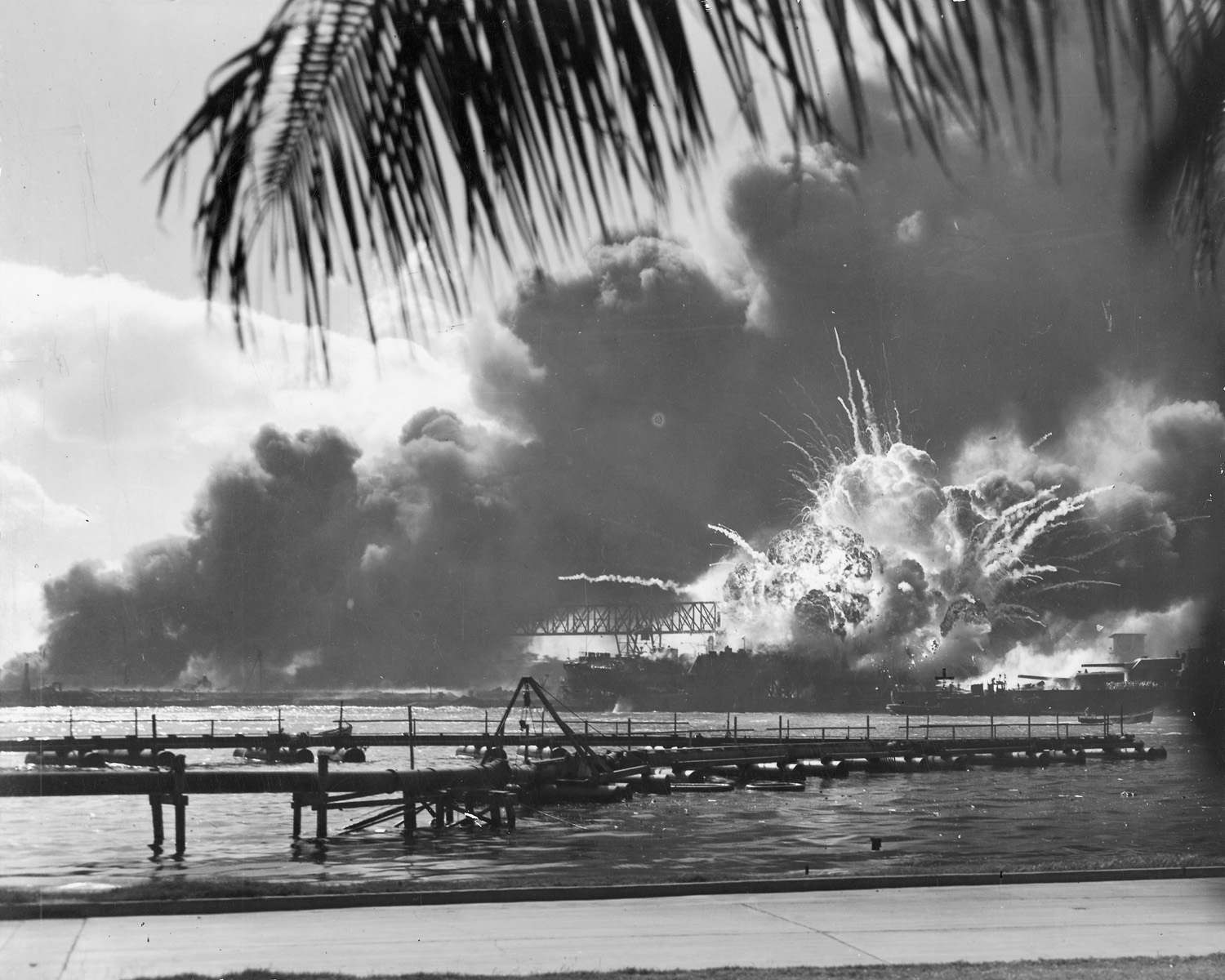
On December 7, 1941, the radio was alive with news of the attack on Pearl Harbor.
 ww2letterproject
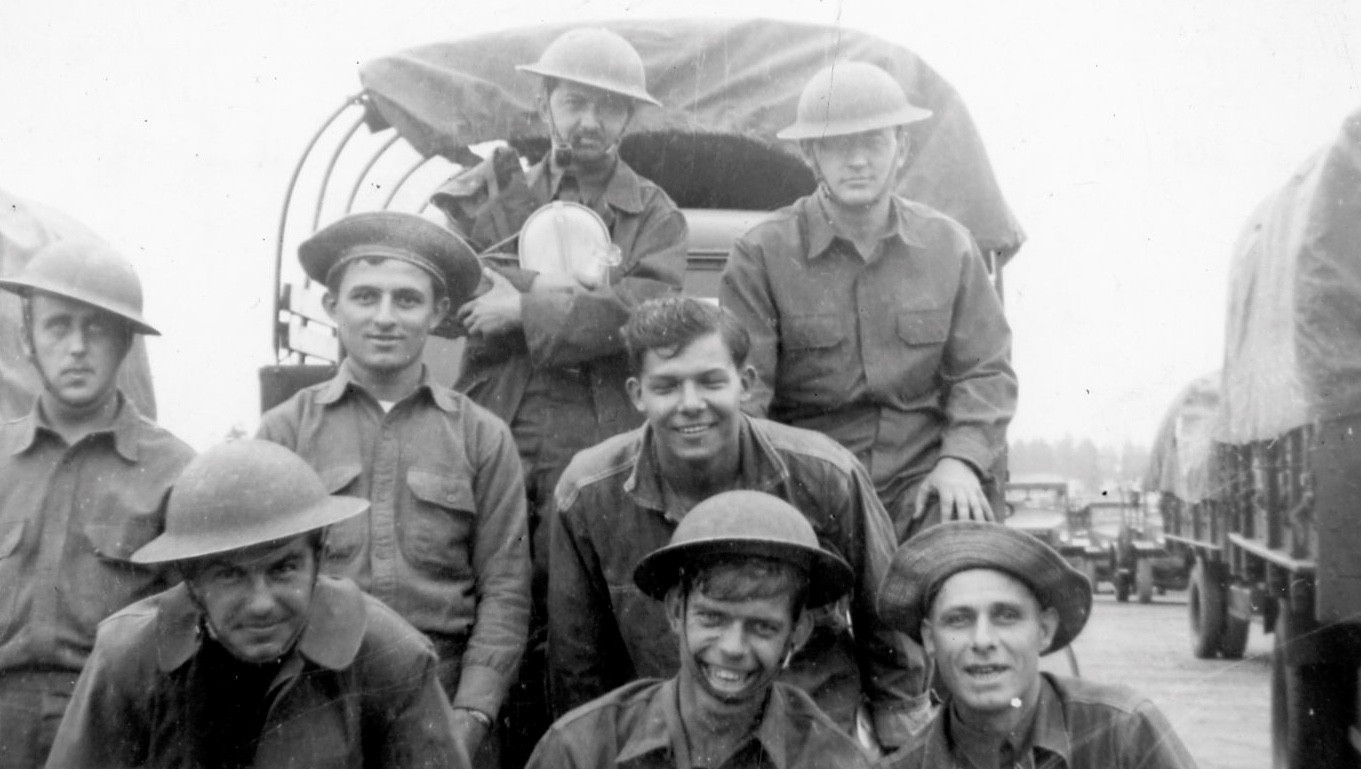
The banner photo is from a collection of war photos of Bill Nance. It is of a group of men from the motor pool of the 136th. Note the helmets. WWI helmets were still in use in 1940. A few months later the more familiar over the ear helmet would be introduced.
Many of the banner photos for subsequent blogs will be from Bill’s collection.
LikeLike
Wonderful so far. Excited for future posts to be released.
LikeLike