
January 1945
Captivity: Days 145-176
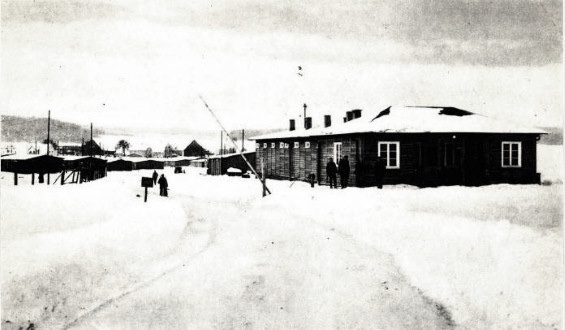
Stalag Weather:
The average high temperature is 36 degrees F; the low 27. About 10 days of rainfall/snowfall in December is normal. The average rainfall/snowfall is 1.65/16.5 inches.
On the War Front:
- The Germans begin a surprise offensive in northern Alsace, their last major air offensive of the war in the West.
- The Japanese increasingly use kamikaze tactics against the nearby US Naval Forces.
- American B-29s bomb Tokyo again.
- Americans land on Luzon.
- Hitler is now firmly ensconced in the bunker in Berlin with his companion Eva Braun.
- Russian troops enter Warsaw. A government favorable to the Communists is installed.
- Russian troops enter Auschwitz concentration camp.
Life Behind Barbed Wire:*
Richard Hartman:
“…As the days went by the theatre was being constricted so that you began to hear the cannonades, …it was coming closer and closer.”
William Bonsall:
“…in camp 3C… we heard that the Russians were coming. …We figured we were going to have to leave, so we each prepared in some way, storing food: bread, apple sauce, we got applesauce, potatoes, we didn’t get them every day, but we stored them away. And I made a little rucksack, a little pack on my back where I could put this stuff… This is where I began to take record… I had a book, …I think …came from the Red Cross.”
parts of the following taken from:
The Great Liberation By Sgt. Gordon B. Pack of Stalag ‘3-C’ Kustrin, Poland
By mid-January the POWs of Stalag III-C were aware that advancing Russian forces were near. As the days passed, hopes for liberation were mixed with feelings of uncertainty. Then the word came.
“On January 30, 1945, we were told that if weren’t out by 6:00 AM (the next day) that the Russians would be at the camp.”
─Abe
The POWs would be moving west towards Berlin and another POW camp. The morning was cold and the ground snow covered. The order came for the POWs to prepare to move out. Many of the POWs began a loosely organized effort to delay departure from the camp.
“The next morning the Germans started to move us out. They would take one room and count [prisoners] then go out and get the next room. While doing that we would return to our room. They finally set up a machine gun and said they would shoot it they had to, so it was time to move. We moved out the front gate.”
Thousands of POWs filed out of the camp main gate moving on foot over a snowcovered road. Some POWs were pushing or pulling sleds or wagons filled with blanket rolls and their scant personal possessions.
About two miles east of the camp, the column of POWs came to a startled halt when machine gun, rifle and mortar fire erupted.
“Tanks fired into the column.”
Chaos ensued. Some men scrambled to the edge of the road looking for cover, many dropped where they were. Five POWs were killed and a number were wounded before the firing stopped.
In Abe’s New Testament he listed the names of fellow POWs. In his journal he wrote: “Sgt. Benny Summey of Knoxville, Tenn who was killed January 31, 1945.”


Among the POWs the word spread that the column was under Russian fire. GIs cautiously got to their feet waving hands and flags. Some German guards fled. By some accounts the guards that stayed were executed by the Russians and left along the roadside.
“We returned to the camp. They [the Germans] tried to take us out again but by then the [Russian] tank column had reached the front gate so we stayed.”
The Germans surrendered and were taken prisoner. Stalag III C was unguarded.
The POWs were free, but where should they go? The Russians offered little or no assistance to the POWs, and within hours left the stalag and moved west toward Berlin. Most of the POWs remained inside the stalag. A few days later additional Russian troops arrived. These Russians ordered the POWs to leave Stalag III-C.
On February 2nd, the Russians moved the POWs east.
“They took us about 2 hours behind the front lines and we were told to find our way to Moscow.”
The POWs organized themselves into small groups. Small groups attracted less attention from the air and from advancing Russian troops. Abe and his band of about a half dozen POWs were malnourished, fatigued, hungry and weak as they set out to walk across Poland and the more than 1000 miles to Moscow.
It was February in Poland where the average temperature is below freezing. Abe was a POW for more than 170 days. Abe who weighed nearly 140 pounds when he was captured now weighed 100 pounds. The group likely started their journey with scant food and effectively no supplies. They didn’t speak the language, and they had no maps.


Life Behind Barbed Wire:*
William Bonsal:
“…Once we got into Poland it was easy. Why? Because we’d walked down the road, we came to a little town. We’d start talking …and a Polish person would run over and say, “Are you British?” “No, we are Americans.” “Americans!” And they would throw up their hands and they would holler, “Come, come, come! They’re Americans!” It was easy to establish a relationship in Poland because it seemed like every third Pollock had a relative that lived in Chicago. So they know English. They had contacts. They understood what was taking place, and they took care of us – meals and so forth. “Yes, go down this road…”
For Abe and his band the journey was more difficult. It is likely the group travelled on secondary roads so as to avoid the attention of advancing and potentially hostile Russian troops.
“Sometimes we would encounter Russian troops. Several times we were lined up against a wall and thought we were going to be shot by a drunken Russian soldier who couldn’t understand why we were going to the rear instead of the front.”

The moment passed and the weak and the exhausted Americans moved on.
Poland was liberated by Russian troops only weeks before Abe and his band left Stalag III-C, after having been under German control for nearly five years.
Abe noted in his journal some of Polish towns through which the group passed and the distances they sometimes travelled.
“Zornburg 20 kil … Viatag 20 kil … Lansberr 27 kil … Zantoch 11 kil”
(20 kilometers = 12.43 miles)
“On the way we even stayed at a Jewish concentration camp and made friends with several Polish people.”

It is likely the camp was near Chelmno, Poland. The Nazi camp near Chelmno was specifically designed to carry out ethnic cleansing through mass killings. It operated from December 8, 1941 until January 18, 1945. At a minimum 152,000 people were killed.
On one occasion Abe recalled encountering:
“…a young Russian girl soldier on horseback with a child held in front of her.”
After several weeks and approximately 400 miles, Abe and his group crossed Poland and arrived at the Russian border.
“They would not let us cross because we didn’t have passports.”
They were forced to turn west and retrace their path. Now their destination was Warsaw, Poland, a journey of nearly 100 miles.
“We lived off the lands, spuds, onions and whatever we could find.”
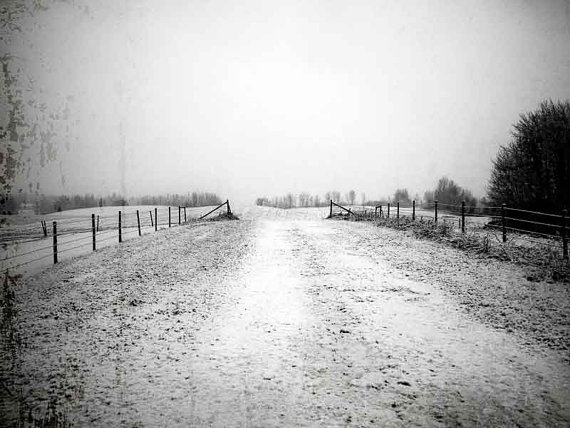
Abe wrote in his journal:
“We are in a home… trying to find out what the situation is. Met with Poles on Feb 8 that spoke English one having lived in the US. It is amusing to see people live in a group when they are on their own and don’t know the language…”
It is likely that near the end of February, 1945, Abe and his group had at last reached the relative safety of a war ravaged Warsaw. They had been on the road for nearly four weeks and had travelled 500 miles. The wandering was over; there was a way home.

Note: From Fanny Banis Kisling’s interview of Abe, there were two sets of directions. Her handwritten notes are as follows: “Kursurin, Zornburg 20 kil, Viatez 20 kil, Lansberr 27 kil, Zantoch 11.” Her typed notes indicate a different sequence of towns: “Landsberg, Friedsberg, Schonlanta, Breiten, Wittkow, Levehnke, Schnerdemuhl and Bromberg.”
I assumed the typed notes were completed after the final interview and therefore represented a more accurate road map of the journey. The names of many of the Polish towns through which Abe and his band passed changed after Poland was liberated from Germany and came under the control of the Soviet Union. I was able to identify several of the towns on the typed list and to establish a somewhat west to east progression of the journey. The following list is a result of these efforts:
Lansberg = Gorzow Weilkopolski
Freidsberg = ???
Schonlanke = Trzcianka
Breiton = ???
Leberhanke = Stara Lubianka
Wittkow = ???
Schneirdemule = Pila
Bromberg = Bydgoscz
On February 20th, Abe wrote in his POW journal:
“…from a Polish girl named Jennie Szuminska-Bydgoszez; ‘Have heart and look in to the heart for sympathy…’”
It is likely that the Polish girl assisted Abe and his group in contacting the Polish Red Cross in Warsaw who was gathering American GIs who were liberated from German POW camps.
Germany’s attack on Poland in 1939 effectively launched WWII. While the retreating Polish Army resisted the advancing German columns, Warsaw’s 1.3 million inhabitants were subjected to furious bombardment. Hospitals, churches and schools were hit. Homeless families crowded the streets, pushing what remained of their belongings in wheelbarrows.
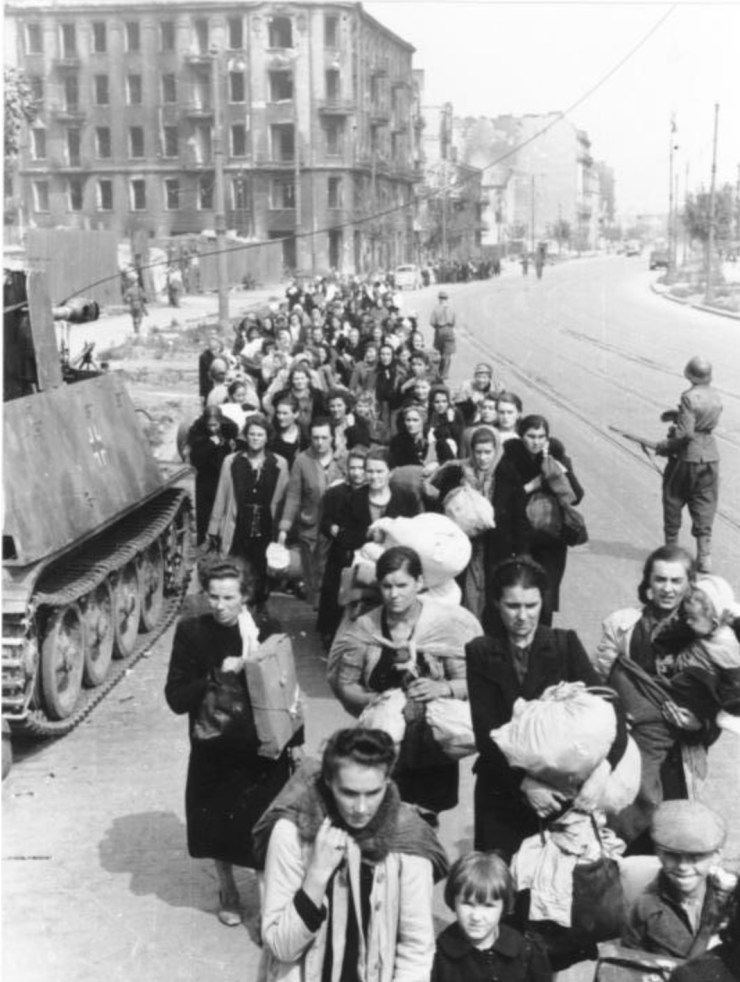
From history.com:
Shortly after the German invasion of Poland, in September 1939, more than 400,000 Jews in Warsaw, the capital, were confined to an area of the city that was little more than 1 square mile. In November 1940, this ghetto was sealed off by brick walls, barbed wire and armed guards, and anyone caught leaving was shot on sight.
In July 1942, Heinrich Himmler, the head of the Nazi SS, ordered that Jews be “resettled” to extermination camps. An estimated 55,000 to 60,000 Jews remained in the Warsaw ghetto, and small groups of these survivors formed underground self-defense units such as the Jewish Combat Organization, or ZOB, which managed to smuggle in a limited supply of weapons from anti-Nazi Poles. On January 18, 1943, when the Nazis entered the ghetto to prepare a group for transfer to a camp, a ZOB unit ambushed them. Fighting lasted for several days before the Germans withdrew.
On April 19, 1943, Himmler sent in SS forces with tanks and heavy artillery to liquidate the Warsaw ghetto. The Germans systematically razed the ghetto buildings, block by block, destroying the bunkers where many residents had been hiding. In the process, the Germans killed or captured thousands of Jews. By May 16, the ghetto was firmly under Nazi control, and on that day, in a symbolic act, the Germans blew up Warsaw’s Great Synagogue.

Life Behind Barbed Wire:*
William Bonsall:
“…We went to Warsaw for almost a month and there is a whole story, of course, behind being taken care of by the people in Warsaw. Clothing, certainly food, bathing, resting at night… And then we heard there was a group coming from Warsaw’s American contingent, coming from somewhere into Warsaw, and they were rounding up all these American prisoners who were floating all over the place, and they brought them all into Warsaw. And they said, “Ok, it’s time to leave here now. Get on the train and this is what you do.” …They put us on a train, in a boxcar, and we went south. All the way down south through the Ukraine area of Russia, all the way down into Russia itself down to the Black Sea and to a big city named Odessa, which is right on the Black Sea…”
*Interviews of American soldiers who spent time in WWII German POW camps by the Library of Congress: Veterans History Project: http://www.loc.gov/vets/
Banner photo: https://commons.wikimedia.org/wiki/File%3ALagerstrasse_-_Stalag_VIII_A.jpg
By Meetingpointmusicmessiaen (Own work) [CC BY-SA 3.0 (http://creativecommons.org/licenses/by-sa/3.0)%5D, via Wikimedia Commons
Next Week: The Journey Home


Could you post the journal? If not, could you write about any mention of names of the other American POWs at Stalag 3C?
LikeLike
Hi! Unfortunately, we haven’t been able to locate the journal itself. Also, the only information we have of the men in the camp with him are the names that he wrote on the inside of his New Testament. Thanks for reading!
LikeLike
I haven’t been able to reply because I really don’t know what to say. Selfishly, I wish I would have been smart enough and interested enough to know all this when Uncle Albert was alive. Of course we knew the bare facts, but to realize the horror he lived through and then to have lived a “normal” life is so remarkable. Words really fail me. Great job Steve and Becca! Thank you.
Emily
LikeLike
Great job on story Steve
LikeLike