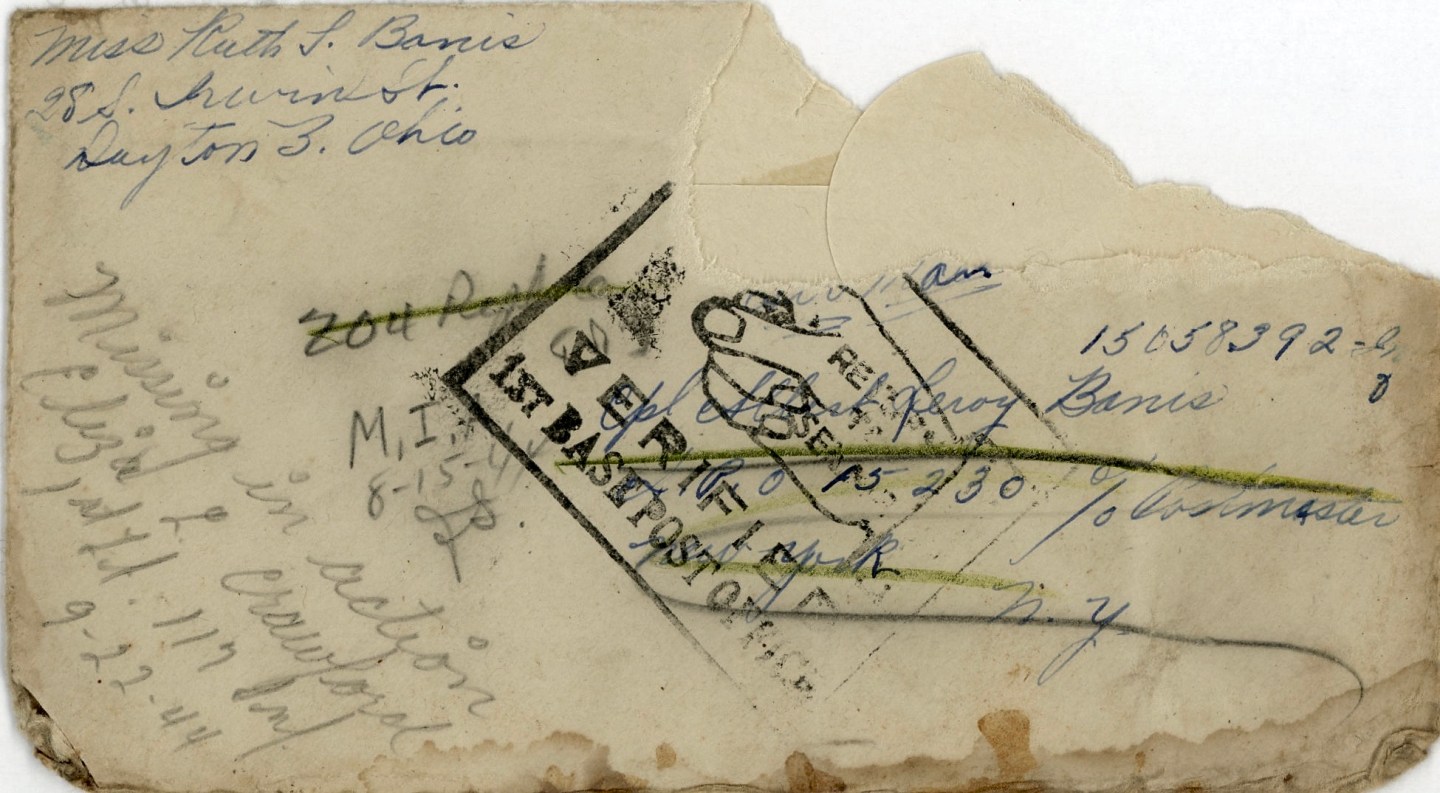
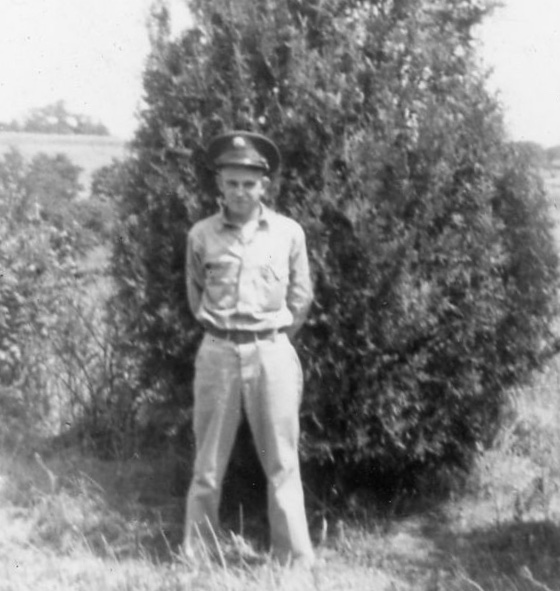
On the morning of August 7, troops of a German Panzer Division surprised elements of company A of the 117th as they prepared to defend an area near Saint Barthelemy, France. The German troops quickly penetrated the defensive line of the 117th. In the chaos that ensued and just before noon,
“I was captured along with about 170 other men of the 117th.”
─Abe
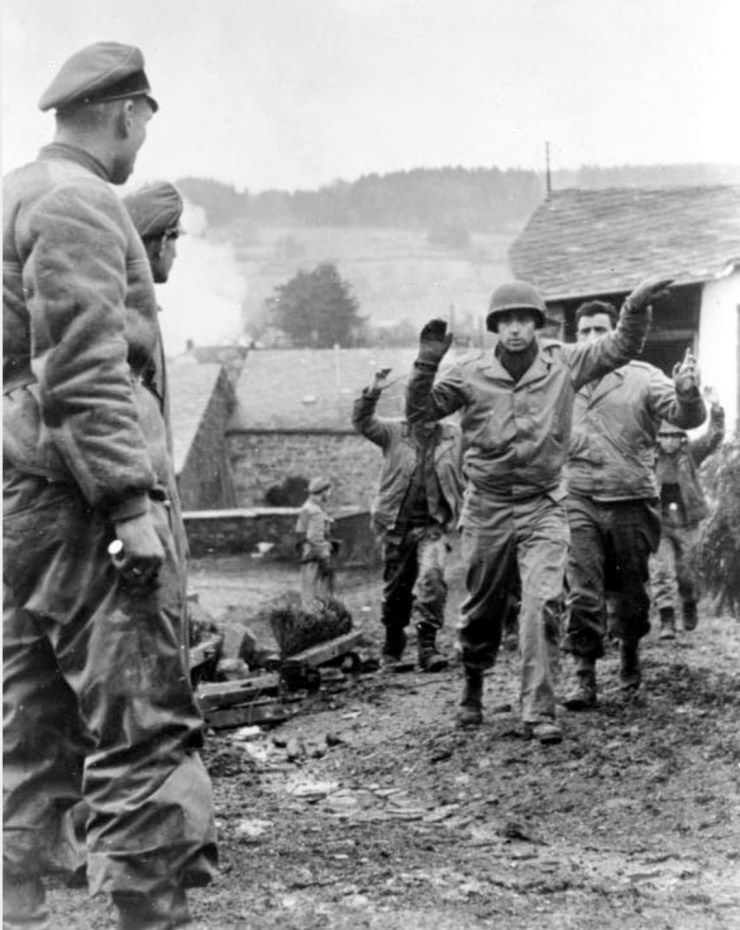
The captured the men were quickly moved behind German lines.
Some of the men of the 30th who were taken captive that day reported that they were not allowed to talk and ordered to hold their wrist and extend their arms over their heads. Any variation from these orders would result in being shot where they stood. Guns, ammo, grenades, water and even K rations were taken.
In some cases the severely injured were executed and their bodies were booby trapped (taken from Hidden Hell by Robert Miller).
Each captured soldier feared the unknown. Would he be interrogated and tortured? Where were they taking him? Would he live? Would his family find out? Would he ever see them again? Would they ever know what happened to him?
“We were marched to a nearby farmhouse and interrogated. After that we were moved to the French town of Alecon.”
─Abe

The march to Alecon was nearly 50 miles. Abe and his fellow captives arrived in Alecon on the morning Tuesday, August 8. Assuming a few short breaks, this march would have lasted about 20 hours.

That afternoon Abe and the other prisoners boarded trucks and began the 70 mile trip to Chartres, France. Along the way American fighter planes attacked the truck convoy.
The fighters swept down toward the convoy, leveled off a few hundred feet above the ground, then opened fire on the lead truck.
“The first truck was put out of commission and most of the men killed or wounded.”
─Abe
Abe was riding in the second truck. It was now targeted by another of the American fighter planes. The fighter plane was likely a P47 or P51, each of which is equipped with six, 50 caliber machine guns. The fighter swept in low and opened fire.

Each of its machine guns firing nearly 800 rounds per minute. A 50 caliber shell is approximately ½ in diameter and 5 inches long.
“We could see the bullets hitting the ground…”
Abe’s truck was hit and
“…The man next to me was killed.”
─Abe
The American prisoners grabbed anything available and begin waving it frantically at the fighters in an effort to identify themselves as the planes circled preparing for another strafing run.
“The pilots seen us waving things in the air and rolled their planes over and waved to us letting us know that they knew who we were.”
─Abe
The battered truck convoy continued to Chartres where it arrived that evening.
The next morning, August 9, as Abe and his fellow captives waited, uncertain as to where and when they would be taken next, Red Cross packages were delivered.


- 1lb can of powdered milk
- 1 package of ten cookies
- 1lb can of margarine
- 1/2 package of cube sugar
- 1/2lb package of Kraft cheese
- 6oz package of K-ration biscuits
- 4oz can of coffee
- 12oz of C-ration vegetable soup concentrate
- 6oz can of jam or peanut butter
- 12oz can of salmon or tuna
- 1lb can of Spam or corned beef
- 1lb package of raisins or prunes
- 5 packs of cigarettes
- 7 vitamin-C tablets
- 2 bars of soap
- 2 D-ration chocolate bars
It is likely that is was the first time Abe and the other captives had anything to eat since being taken as prisoners two days earlier.
Abe and the other captives left Chartes and traveled 50 miles to Paris, arriving there August 10. Paris would be liberated by Allied forces just 15 days later on August 25th.
In Paris, Abe and his fellow captives were combined with allied prisoners from other fronts and herded onto boxcars, forty men were assigned to each car.
It is likely they were boarding a standard French railroad boxcar known as a “Forty and Eight.” Each car was designed to transport 40 men or 8 horses. These cars traveled on the narrow gauge railroads of France and had little more than half the capacity of American boxcars. The cars were stubby, only 20.5 feet long and 8.5 feet wide. These infamous boxcars were used during WWII to transport troops to and from the front.
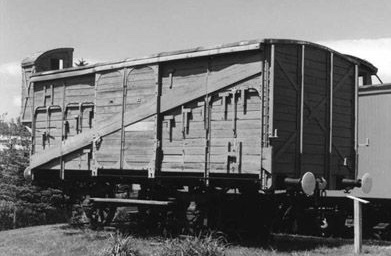
Many American troops (including POWs) were transported in a rough-riding 40 and 8. Veterans’ memories of travel in the rickety, unheated cars on long slow trips were pretty vivid and not pleasant.
With 40 men in a car and allowing adequate space for the sick and injured soldiers, meant Abe and the other “healthy” captives each had less than 2ft x 2ft of floor space. It was August in Paris, where the average high daily temperature is 80 degrees. The poorly ventilated cars were certainly at times much hotter than 80 degrees. On some of the box cars there was a five gallon lard can to be used at a waste facility.
The train headed east out of Paris and stopped at the French town of Chalon where,
“[We] were searched and all of [our] belongings taken.”
─Abe
Almost everything was taken. Before he left to go overseas, Velma had given Abe a small pocket sized book as a Christmas gift. The German guards allowed Abe to keep it.
Shortly thereafter an inspection by German guards of the box car on which Abe was riding, revealed that,
“…Boards had been taken from the car and one man was missing. It was a British captain that had been captured and escaped several times. He was put on a car with both arms in slings and one leg in a cast, he used crutches to walk.”
─Abe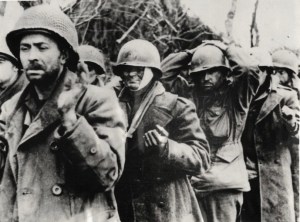
After the German discovered the escape, they emptied the box car and split the remaining captives into two already filled box cars. Now each car had 60 men, reducing the average space for each man to less than 2ft x 1ft.
“There was not enough room for everyone to sit down so most had to stand except those that was in bad shape…”
Leaving France the train arrived at the German border where the train stopped at the town of Trier.
“…We were registered as German POWs and while at the camp could see clouds of dust in the distance, and were told that is was Patton’s Army coming, and it didn’t take long for them to load us into train cars for our trip in to Germany.”
─Abe
On August 12, 1944, as the train moved slowly east, Abe “celebrated” his 22nd birthday.
August 13 was likely a hot summer day. The box car remained closed all day. Most of the more than sixty, thirsty, hungry, tired men stood shoulder to shoulder. Then, as Abe would tell his wife in a letter written from prison camp,
 “Honey remember the book you gave me for Christmas of 1942…there was a church service read from it on August 13, 1944; while sitting in a boxcar…”
─Abe
“They kept the car closed for three days and they didn’t give us food or water.”
The train moved east and farther behind enemy lines. On the fourth day of the train trip,
“They gave us three raw eggs to eat and some water.”
Later that day the train reached Berlin where it came to a stop.

“We ended up in a rail yard while the Allies were bombing the city and the factories. After the bombing was over we went on.”
─Abe
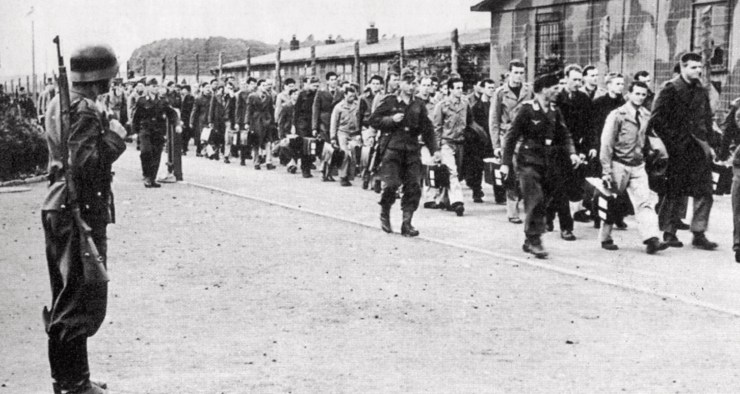
Leaving Berlin the train traveled about 40 miles east before it stopped again near the town of Kurstin, Germany. It was August 14, 1944 and the POWs had reached their destination. It was Stalag III-c.
Next Week: POW
 ww2letterproject
I agree with Jo Ellen. To think that this ordinary mid-western family could have such a tale to tell. Thanks again Steve for all your effort and perseverance. It’s so easy to say “oh I should, or I could” but you did. We’re all the richer for it.
Emily
LikeLike
This is another fascinating account from the Banis family. I am so enjoying reading and have such respect for them and what they did and what they endured. Thanks for posting! Jo Ellen Aleshire
LikeLike
Life is made of moments. I think about some of the comments by my Uncle Al (Abe). For example, during the fighter strafing attack on their POW truck he comments about seeing the bullets “strike the ground” and the “man next to me was killed.” What was he thinking in that moment watching the plumes of dirt spring from the ground as the 50 caliber bullets hit and marched towards the truck? Knowing almost exactly when you would feel the impact. Then the bullet misses you by inches and man next to you is hit. I thought about posting a picture of a 50 caliber bullet exit wound but it was too graphic.
I have lunch occasionally with a friend who is a Korean War era vet. He once said “you, know those WWII guys, one thing about them is after they came back they were fearless, they had seen it all.” Still there had to be nightmares. My dad served 3 ½ years in the South Pacific during WWII. Mom said he suffered from occasional nightmares for years. He also drank, sometimes, a lot. I suppose there were many reasons for it but I can’t help but think that at least one reason was trying to burying memories about the war.
LikeLike
Al was a hard fighter all of his life, first in the war, secondly for his family and finally for his life in a losing battle to cancer. As a child growing up, I didn’t realize how hard him and mom had to work for us to survive.
He was a surviver and taught his children the same lessons. They never collected food stamps, welfare or hand outs. As an adult I believe he was my best friend and when he retired I would stop every morning on my way to work for coffee to go as he still got up early. Miss him.
LikeLike