This is a story about my Uncle Bill and our family. He joined the US Army in 1942. While he was away from the family he wrote often to his mother until he was killed in action in 1944, at the age of 23.
Numerous families experienced a similar story. There were over 400,000 US Armed service casualties during WWII. Many sacrificed much to save the world. They were all heroes, those brothers and sons lost on the battlefield and their families.
I hope that you can share the experience and be as moved by the letters as I was. It is a wonderful story about duty and sacrifice, family and friends, love and dreams. The letters are from places far away, but the words reveal the closeness between a wonderful mother and a son who adored her.
— Steve Nance
PROLOGUE
I adore my mother, Ruth Banis Nance. She is almost 91 years old and resides in an assisted living facility. She moves slowly but has a quick wit. We chat on the phone almost every day. I make the four-hour drive and visit her for a few days several times a year.
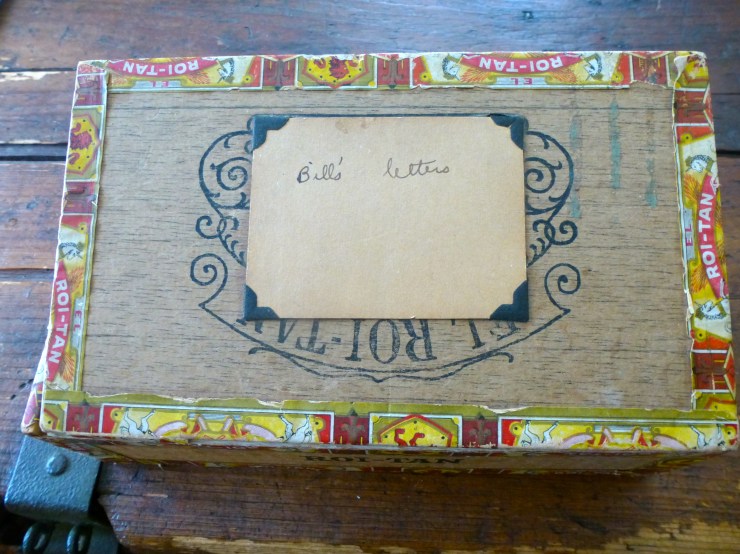
Mom sold her house a few years ago. During that painful process, my sister Carol and I salvaged some of Mom’s memories; a few storage containers went into Carol’s small apartment and a few went into my basement. Before I visit Mom, I often search the containers and take along something we can share: e.g., a collection of holiday and greeting cards she saved from years past. We spend a few hours reminiscing. On one recent visit I took a container without first searching its contents. Sitting in Mom’s small room, I opened it and saw that it contained papers that had belonged to her mother, Anna Banis. Searching for something more interesting than medical bills and deeds, I reached the bottom of the container and discovered a cigar box labeled “Bill’s letters.” Inside was a stack of letters, many in the original envelopes.
I knew very little about my Uncle Bill other than that he had died in combat during WWII. I carefully pulled a letter from an envelope and began slowly reading the cursive handwriting on the yellowing note paper.
It was easy to imagine it was 1943. Anna Banis wasn’t my short, round, silver-haired grandma with the bright eyes and frequent laugh, but the 44-year-old mother of 11 kids. She was probably very tired but taking a moment out of a hectic day to cherish a letter from her oldest son. The earliest letters were sent from an Army training camp stateside, then later from the European War front. Grandma and Uncle Bill wrote often to each other–a personal dialogue between a mother and an adoring son. Personally, it felt familiar. I returned home with the cigar box and its contents. I carefully dated and organized more than 70 letters from Bill Banis to his mother, Anna, starting in 1938 and ending with his death on the battlefield in 1944. I read and reread them all. I followed Bill as he left Eaton, Ohio in 1939, at the age of 17 to serve in the Civil Conservation Corps (CCC) in Nevada, through his western adventures, his induction into the army, basic training, deployment and then the war.
I wondered what life was like for Anna Banis and her family as they read these letters, living in a small town, waiting for the postman. By mid-1941 they and the country stood on the brink as a war raged in Europe and Asia. Then came December 7, 1941, and the country and every family in the US was swept up in the current that would carry away sons and brothers to distant lands where they would face hardship and peril. It was a world war that would threaten not only several of Anna’s children who served in the US Armed Forces, but also the very world in which she and her family lived.
Acknowledgements: Thanks to Ruth Banis Nance, Fanny Banis Kisling, Victor Banis, and Emily Kisling Medearis. Thanks also to the Camp Van Dorn World War II Museum, Mike Stewart, director for sharing photos and information. A special thanks to Rebecca Nance for the creation of this blog site and to my editor, Pat Nance.
 ww2letterproject