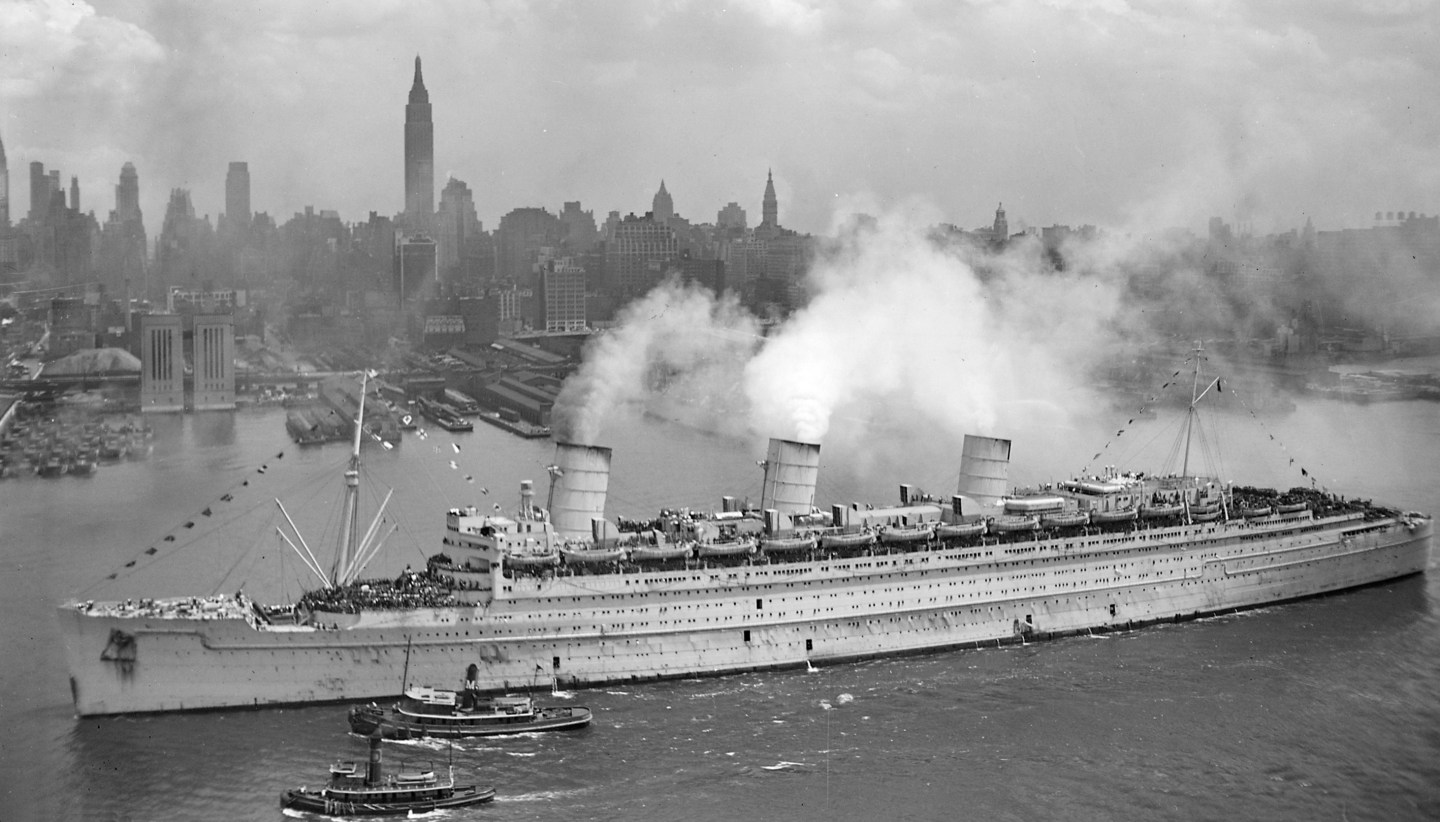
March 1945

On the War Front:
- The US firebombs a number of cities in Japan, including Tokyo. There are numerous civilian casualties.
- V-2 rockets continue to hit England and Belgium.
- Iwo Jima is finally secured after a month’s fighting; it is the only time that the number of American casualties outnumber the Japanese.
- US and British forces cross the Rhine.
- The Western Allies slow their advance and allow the Red Army to take Berlin.
- General Eisenhower broadcasts a demand for the Germans to surrender.
The Polish Red Cross played an important role in the care of the American ex-POWs that were gathering in Warsaw. They arranged to transport them by train to the Russian port of Odessa.

At the Yalta conference in February 1945, FDR, Stalin and Churchill met to discuss the re-establishment of the nations of war-torn Europe. FDR and Churchill intended for the nations to be democracies. However, as the Russian Army moved through Eastern Europe, they left behind Russia controlled governments. Stalin insisted on the use of Germans to man labor camps to repair Russia’s war damages. Concerned for the fate of the thousands of US POWs who would be released in Russian controlled countries, the US negotiated an agreement to provide care for these GIs.
A strained relationship between the US and Soviet Union was apparent as shown in the following exchange between Averell Harriman, US Ambassador to the Soviet Union and Russian Embassy officials.
EMBASSY OF THE UNITED STATES OF AMERICA
3 March 1945
My dear Mr. Molotov,
In the absence of Mr. Vyshinsky I am writing to you about the liberated prisoners of war. Yesterday evening, I was informed that approximately 1,200 officers and enlisted men of the United States, former prisoners of war, arrived in Odessa awaiting repatriation. My government expresses its profound gratitude to Soviet authorities for the energy and concern shown in assembling this first large group of Americans.
Deep gratitude is also expressed to the Polish Red Cross for the assistance it has provided in many cases to these officers and enlisted men to improve their living conditions.
I have received reliable information that approximately 3,000 of our former prisoners of war remain in Poland. Many of them are sick, others are scattered in groups in various parts of Polish territory and are in difficult conditions. When I visited Mr. Vyshinsky on February 26, he told me that according to information available to him, all American liberated prisoners of war, including those that were ill, were in trains on their way to Odessa. He was also kind enough to report that if any more liberated prisoners of war were found, my request to him would be looked upon favorably.
… In addition, I request that American airplanes in Teheran and in Poltava be permitted to fly to Poland to transport supplies needed to alleviate the suffering of these former prisoners of war, as requested by General Dean. I also request that on their return from Poland to Poltava these airplanes be permitted to evacuate the sick and wounded for treatment in the American hospital in Poltava.
Soviet agencies have not yet permitted the use of these airplanes with a U.S. crew for this purpose, as General Dean and I have requested. You will recall that in the agreement reached with the Soviet government in Yalta it was envisioned that each Party, by agreement with the other Party, should be given the opportunity to use whatever of its own transportation assets that might be used to repatriate its citizens and to transport supplies to them. Certainly the use of our airplanes, which are ready for the purposes outlined above, meets the letter and spirit of the Agreement.
I wish to repeat that we are very grateful to the Soviet Union for what has been done for our former prisoners, but I am sure You will agree that the terms of the Agreement reached in Yalta should be implemented in all respects. I wish to thank you in advance for considering all these questions.
Sincerely yours,
W.A. Harriman
Note: Harriman would run for the US Presidency in 1952 and later become governor of New York, US Ambasador, a US member of the UN, and Secretary of State.
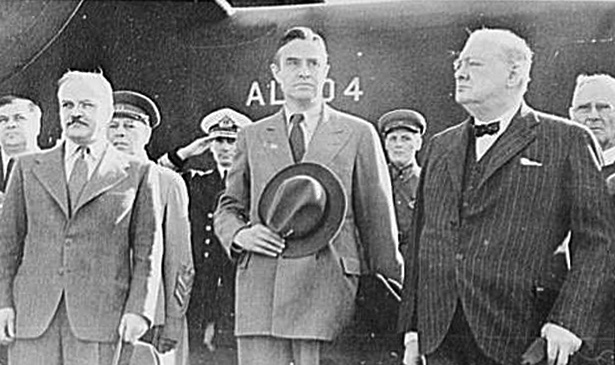
The Soviet Union Embassy responded to the Harriman letter with the following report.
R E P O R T
On the organization of transit camps and a transfer point in the city of Odessa as of 22 March 1945
I. BILLETING
…a total of nine buildings …have been allotted… for transit camps. These buildings can accommodate 8,500 persons, 800 of them officers. All rooms have been readied and equipped with all necessary furnishings. All buildings have been provided with plumbing, electrical power, dining facilities. However, there is an insufficient number of wash stands and field latrines.
The officers are to be housed in separate rooms, four to a bed; plank beds are being constructed for enlisted personnel. As of 22 March 1945, two-tiered plank beds for 500 persons have been constructed. Small metal stoves have been installed in the rooms.
…for the transfer point…military housing area has been re-equipped with plumbing and electricity; dining facilities have been built and equipped and washstands and field latrines installed. People are being accommodated on the floor on straw mats.
Accommodations in transits camps and in the transfer point are satisfactory, but require a number of improvements.
II. PASSAGE OF CONTINGENTS
As of 22 March a total of 11,711 Allied prisoners had arrived; of them:
British 2,163
Americans 2,486
French 7,062
Departed on three vessels from March 7…
In mid-March of 1945, Abe boarded a train in Warsaw bound for Odessa, nearly 600 miles away.
“They took us in freight cars to Odessa.”
─Abe
It was likely an uncomfortable trip, but this time the box car was headed toward freedom and not a German stalag.
By late March Abe was aboard a ship and left Odessa.
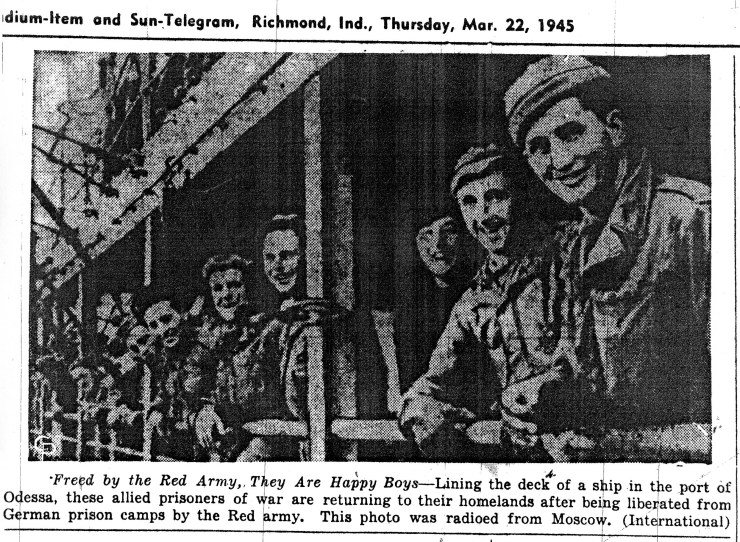
In a newspaper interview several months later, Abe would comment that he was in picture shown above.
“We left Odessa, Russia on the British ship, the Duchess of Bedford.”
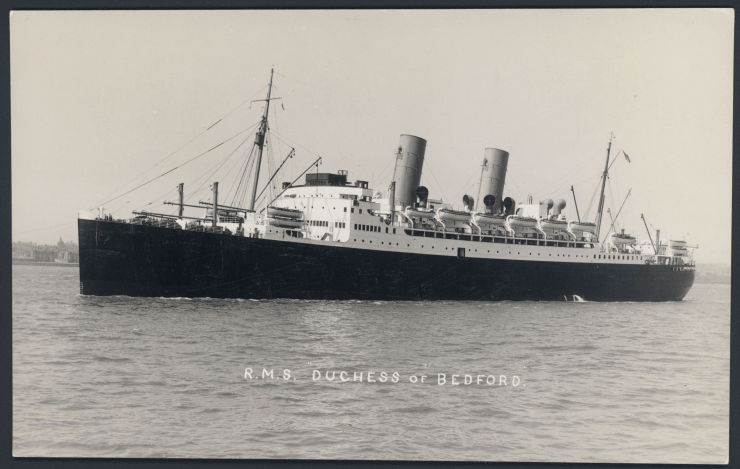
The Duchess of Bedford known as “Drunken Duchesses” for her performance in heavy seas, was a converted Canadian Pacific liner which carried 1500 passengers and 500 crew members. Her maiden voyage was in 1928. She was converted to a troop ship in 1939.
“We left Odessa… stopping in Turkey,…Malta, Greece, …Egypt, then on to Marseille, France”
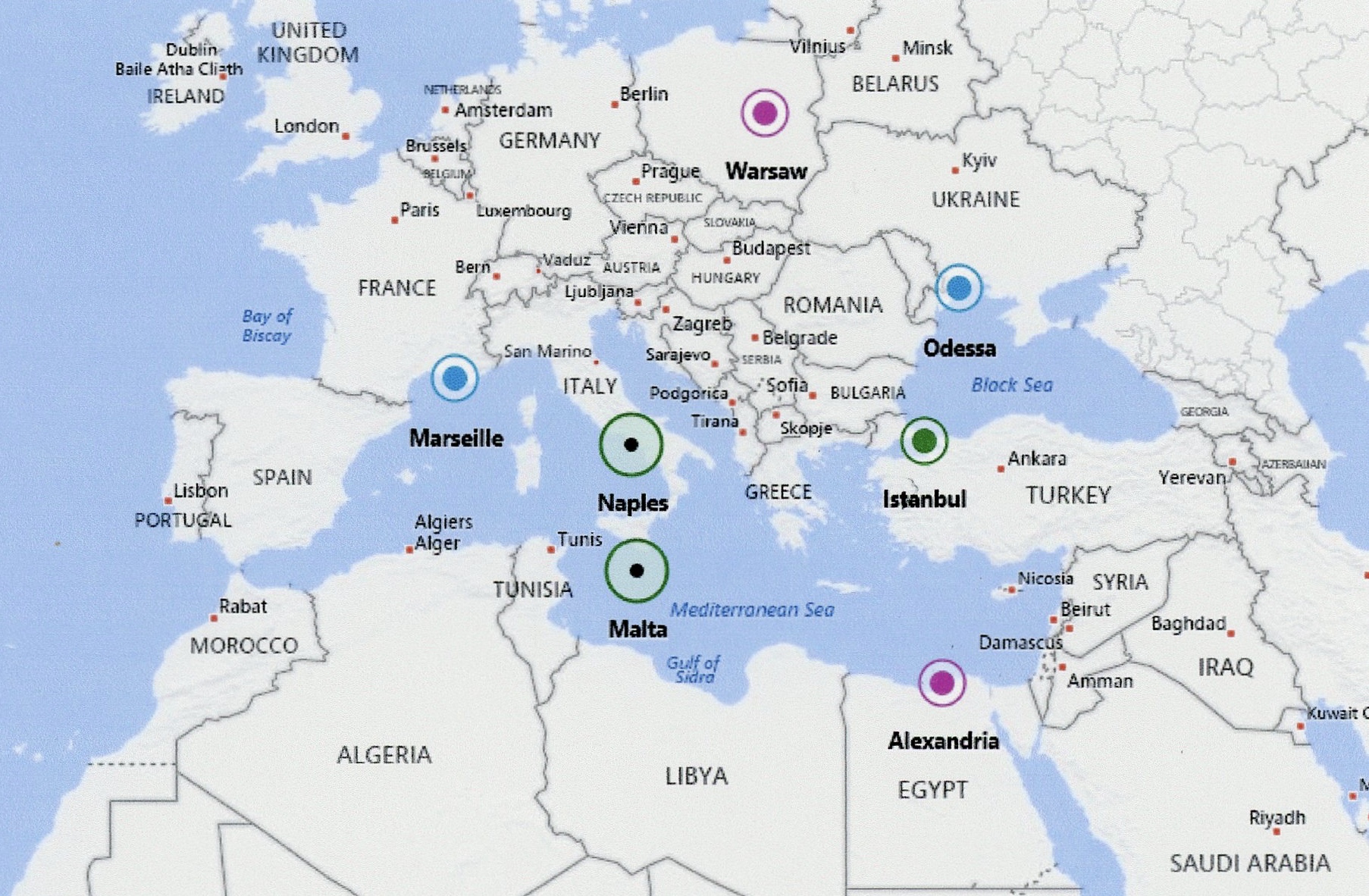
At Marseille the GIs were not allowed to get off the ship. Instead,
“[We] took on some intelligence officers and they took us back to Naples, Italy.”
Once they arrived in Naples, Abe and his ex POWs were now under the jurisdiction of the American forces.
“They gave us new clothes and questioned us some.”
Life Behind Barbed Wire:*
William Bonsall:
“…We got to …Naples, Italy… [and] came under American control. At this time… we got de-loused, we got fed, we got new clothing,…registrations and records and everything.
“…We met quite a few solders that were coming from other ships …we stayed… about a week and we’d go downtown and visit the shops and stores.
“Got on a …boat… a big liner and it didn’t take long and we came into Boston. It was around Easter time.“
William Bonsall, like Abe, served with the 30th Division and was captured at Mortain. He was a POW in Stalag III-C and escaped to Warsaw after the stalag was liberated by the Red Army from there he was transferred to Odessa.
*Interviews of American soldiers who spent time in WWII German POW camps by the Library of Congress: Veterans History Project: http://www.loc.gov/vets/
“They put us on a ship and shipped us back to the US. We landed in Boston, Mass.”
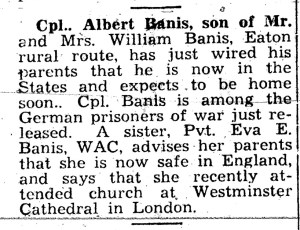 When Abe arrived in Boston he wired his family that he was alive and well and coming home.
“[We] went to Camp Miles Standish where we were kept for a few days”
Abe was given a week or so of R and R.
Abe’s son, Ron, recalled the family story, “When dad came back to the states, he did not return home right away as he stopped with a friend and drank for a couple of weeks before my mother tracked him down and told him to come home if he wanted his family.”
“[We were] sent to a camp near our homes and given leave to visit our families.”

Abe left Boston and returned home on a 60-day leave.
Abe had crossed the Atlantic twice, walked on Omaha beach, and journeyed through ten countries. He had seen the cities of Boston, Paris, Berlin, Warsaw, Odessa, Istanbul, Marseille, and Naples. Abe had traveled by train, ship, motor vehicle and foot about 13,500 miles, the equivalent of a journey more than half-way around the world. Abe had experienced combat as an infantryman, and life as a prisoner of war, and he had suffered through a long and harrowing escape across Eastern Europe.
Abe was 22 years old. He would soon see his wife Judy (Velma) and his two sons, Bill and Ben.
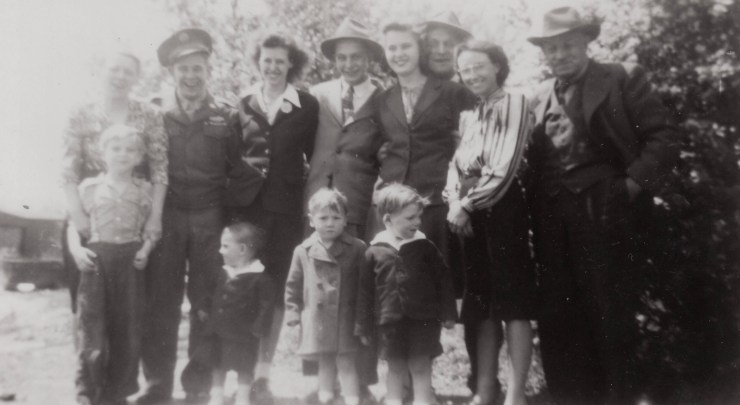
He arrived home in late April. A few days later his mother would throw a homecoming party.
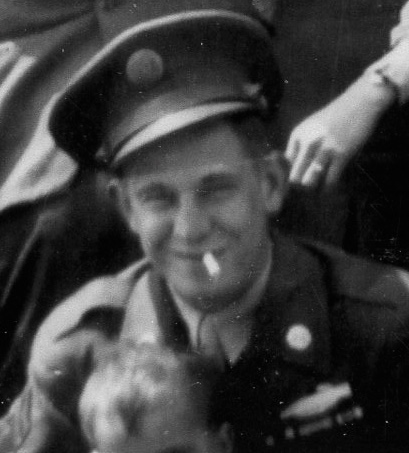
Next Week: Epilogue
 ww2letterproject
Good afternoon. I’m Jennifer and Abe is my grandpa and I am Tom’s daughter. I have a question for you because we are building cabins and RV park in Pipe Creek Texas and have named it after my grandpa. Al’s Hideaway Cabins and RV rentals, LLC. I would like to ad your link to out website that is currently being built to share my grandfathers story if that is OK with you?Jennifer 281-794-2966
Sent via the Samsung Galaxy S7 edge, an AT&T 4G LTE smartphone
LikeLike
Hi, Jennifer! Thanks for reaching out! Please feel free to link to our website on yours. We’re in the process of adding a story and reformatting a bit, so the site may not be accessible for a little while. That said, it should be back up and running by Memorial Day, if not before, so stay tuned. Nice to hear from you. Be well. –Rebecca
LikeLike
When I think back to what I was doing at 22-just beginning married life, with two small children-this man and his peers had already survived a lifetime of experiences, most of which none of us should ever experience. And then to come back to a “normal” life. And that’s what he did-lived what we all saw as a normal life. Never realizing the nightmarish memories he took with him. This story not only shows just how cruel man can be to his fellow man, but that he can also survive that cruelty and not pay it forward.
In reading all this I also think about how happy Grandma must have been, especially after losing Bill. I’m sure her heart was ready to burst.
Emily
LikeLike